
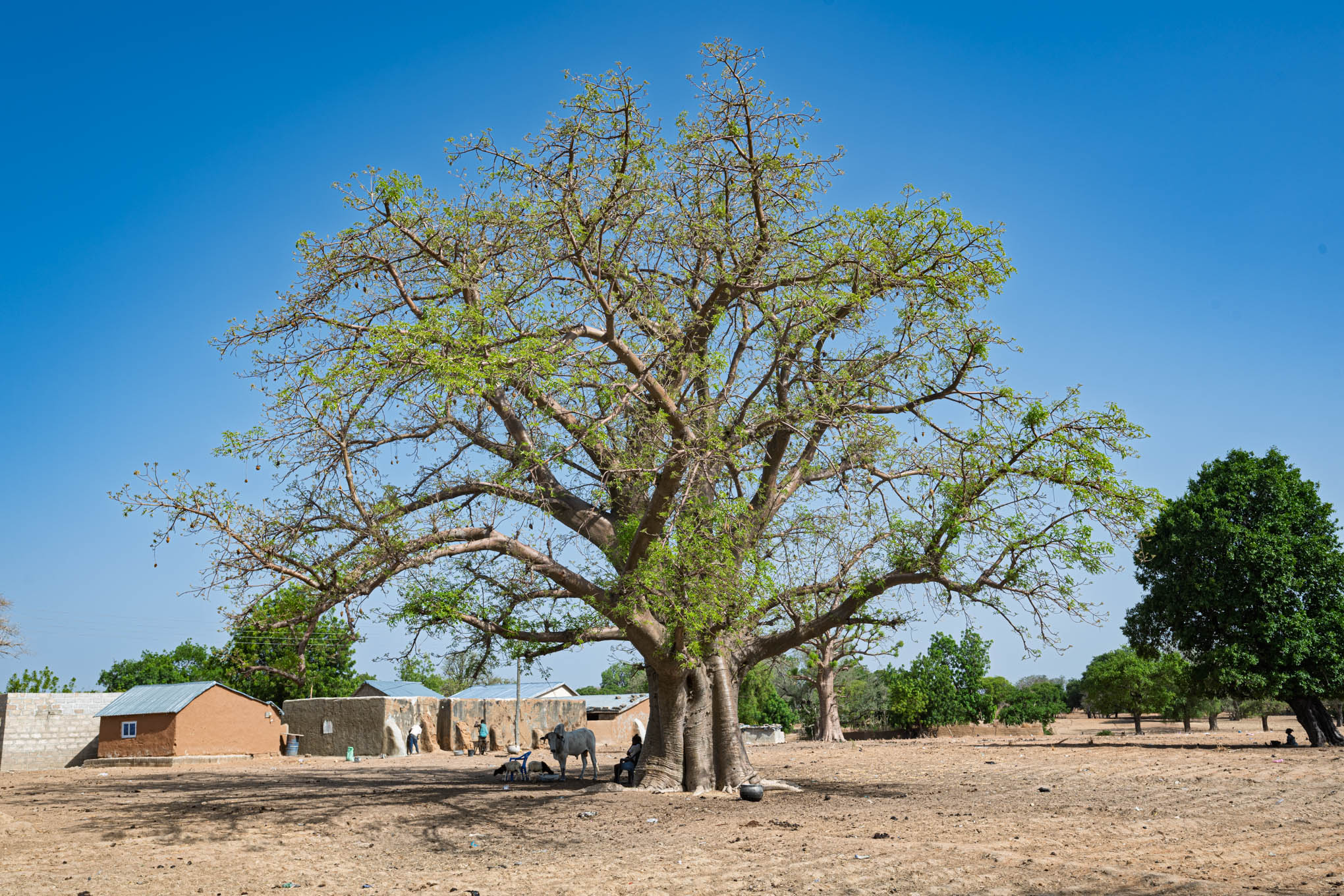
The baobab tree has a most significant importance to the people of northern Ghana. The leaves and fruit provide an excellent source of nutrition while the bark has medicinal values. And it’s a magical tree venerated by the locals.
My colleague, Scott Christiansen, travelled to the village of Punga, just a few klicks south of the border with Burkina Faso in northern Ghana, for the Crop Trust to learn how a women’s association uses the baobab tree to its fullest potential. We sat for several hours in the shade of an centuries-old baobab as the women shared their stories. They then showed us how they harvested the leaves and cooked up a baobab soup.
The local extension agent, Kaba, translated as the Kasema women spoke in their Kasim language. It’s a rare language only found in that particular region of Ghana. I thought I had mastered the Kasim word for ‘smile’ but every time I said it to my subjects as I shot photos they burst out in laughter.
As midday approached and the temperature reached around 38 degrees C and the shade of the baobab disappeared, we thanked the women and started packing our gear. They broke out into a spontaneous song and dance, not minding the extreme heat. Kaba explained that they were singing their appreciation to us for coming and taking an interest in their livelihoods.
After the women had taken turns to dance, they directed their song at Scott and me and beckoned us to dance. We didn’t want to disappoint so Scott entertained them with an Evil Eye Fleegle jig from Lil’ Abner, while I tried to mimic the women’s dancing but ended up with some ridiculous chicken strut.
Scott and I both were amazed at the opportunity we were given to spend time with these extraordinary women and had to pinch ourselves to believe we were in that village sitting under that baobab tree.