AMERICA TURNS 250. BUT MY FAMILY’S REVOLUTION BEGAN IN 1774
·
In 1774, at the age of 47, my fifth great-grandfather, James Ward, went to war. And never came home.
Trouble had been building along the western frontier of the British colonies in America. Under the 1768 Treaty of Fort Stanwix, the Iroquois had signed away lands south of the Ohio River – present-day West Virginia and Kentucky. The problem is those lands weren’t the Iroquois’ to give. These were lands the Shawnee and Mingo had hunted for generations, their roots in the valleys older than any treaty. As settlers pushed in, they and their allies fought back.
In 1773, a party that included Daniel Boone’s 16-year-old son James was ambushed and killed. The deaths were reported with horror in the East. For families like my Ward ancestors who lived on the fringes of known civilisation at the time, the fear felt too close to home.
The Governor of Virginia, John Murray, 4th Earl of Dunmore, declared war on the Ohio nations and called up a volunteer militia.
When the call went out, Grandpa James lost no time. You would think a man of 47 with seven children had earned the right to stay home. But 16 years earlier his three-year-old son John had been taken by the Shawnee, and James had never stopped hoping to find him or perhaps to seek revenge. James’s eldest son William – six years old on the day his little brother was snatched – was old enough now to march at his father’s side.
James had been commissioned a captain in June 1774 and had served in the French and Indian War, so it fell to him to raise volunteers. When he reached the rendezvous at Camp Union, present-day Lewisburg, West Virginia, he had gathered a company of just nine. He was captain; William served as sergeant.
The Botetourt County troops of Virginia were led by William Fleming, a Scottish-born surgeon. James’s small company was attached to that of his brother-in-law, Captain Matthew Arbuckle. The two men had married the Lockhart sisters – James the elder, Phoebe, and Matthew her much younger half-sister, Jane.
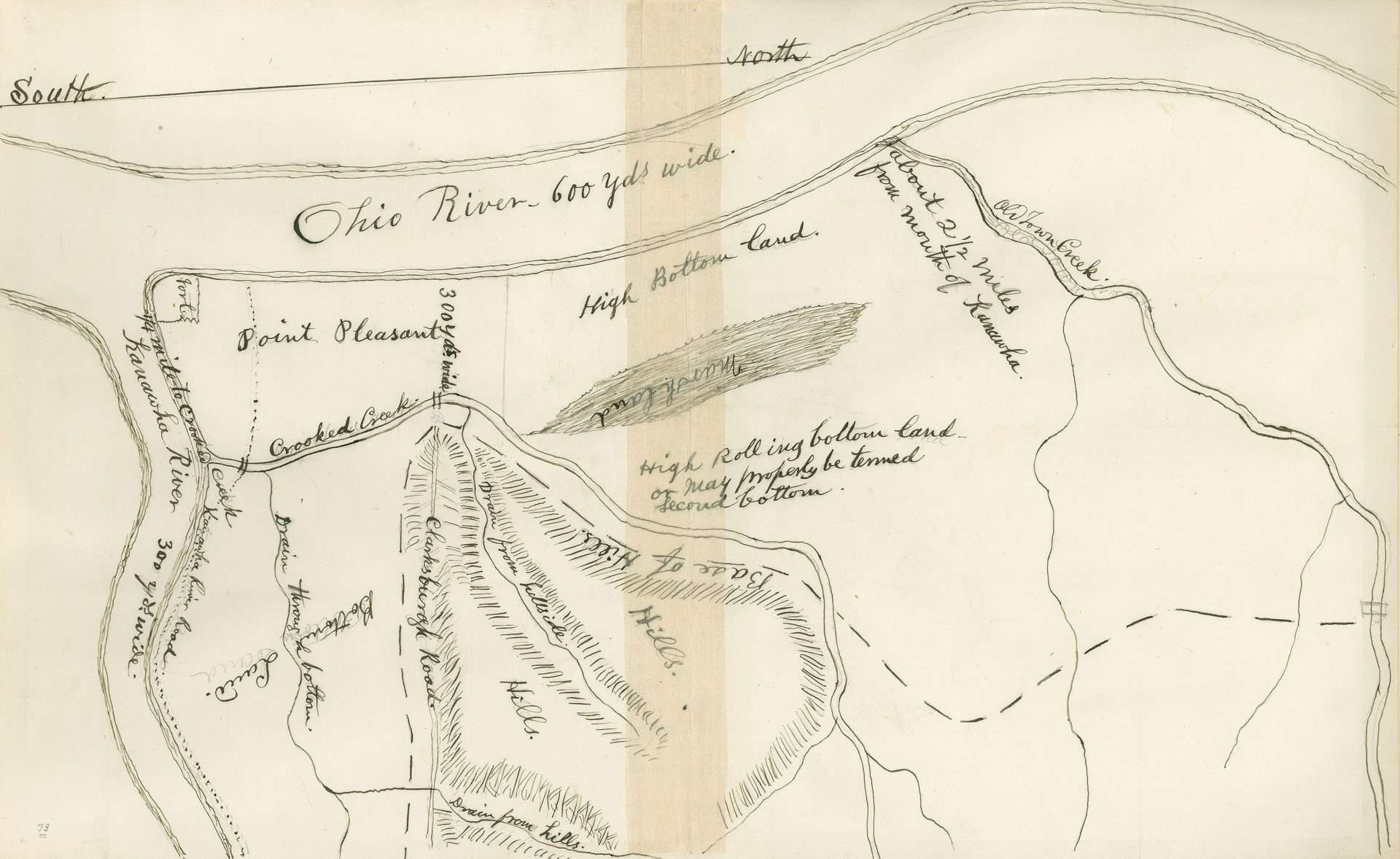
On 6 September 1774, fifes and drums struck up as the Augusta regiment, under Colonel Charles Lewis, set out for the mouth of the Kanawha, where it meets the Ohio at present-day Point Pleasant. The plan was to join Lord Dunmore’s division who were travelling from Fort Pitt – modern-day Pittsburgh.
After two weeks of rain-soaked marching, the men reached the Elk River and built canoes to carry them the last miles down the Kanawha. By 6 October they stood on the Ohio, 160 miles and nearly four weeks from where they had begun. They camped in the triangle where the rivers met and lit fires against the cool autumn nights. They were a rag-tag mob – the best backwoodsmen and marksmen on the frontier, yet they looked more like a hunting party than a trained army.
Wisconsin Historical Society, Draper, Lyman Copeland, 1815-1891, A map of the site of the Battle of Point Pleasant. Date Created: 1876. https://www.wisconsinhistory.org/record/image/W01400W
Dunmore’s division, who were expected to arrive first, was nowhere in sight. Andrew Lewis, the expedition’s commander, decided not to wait for reinforcements and had planned to cross the Ohio the next day.
At dawn on 10 October, two militiamen slipped out searching wild turkey – tired, no doubt, of stringy army beef. A mile north the morning fog parted. They didn’t find turkeys but a long line of battle-ready warriors.
During the night, about a thousand Shawnee, Mingo, Delaware and Wyandot had crossed the Ohio and moved into position around the sleeping camp, a bold night approach led by the Shawnee chief Cornstalk. In the thickening river fog, they had crept close enough to see the militia’s fires. One turkey hunter was killed; the other ran back crying that he had seen “five acres of Indians.”
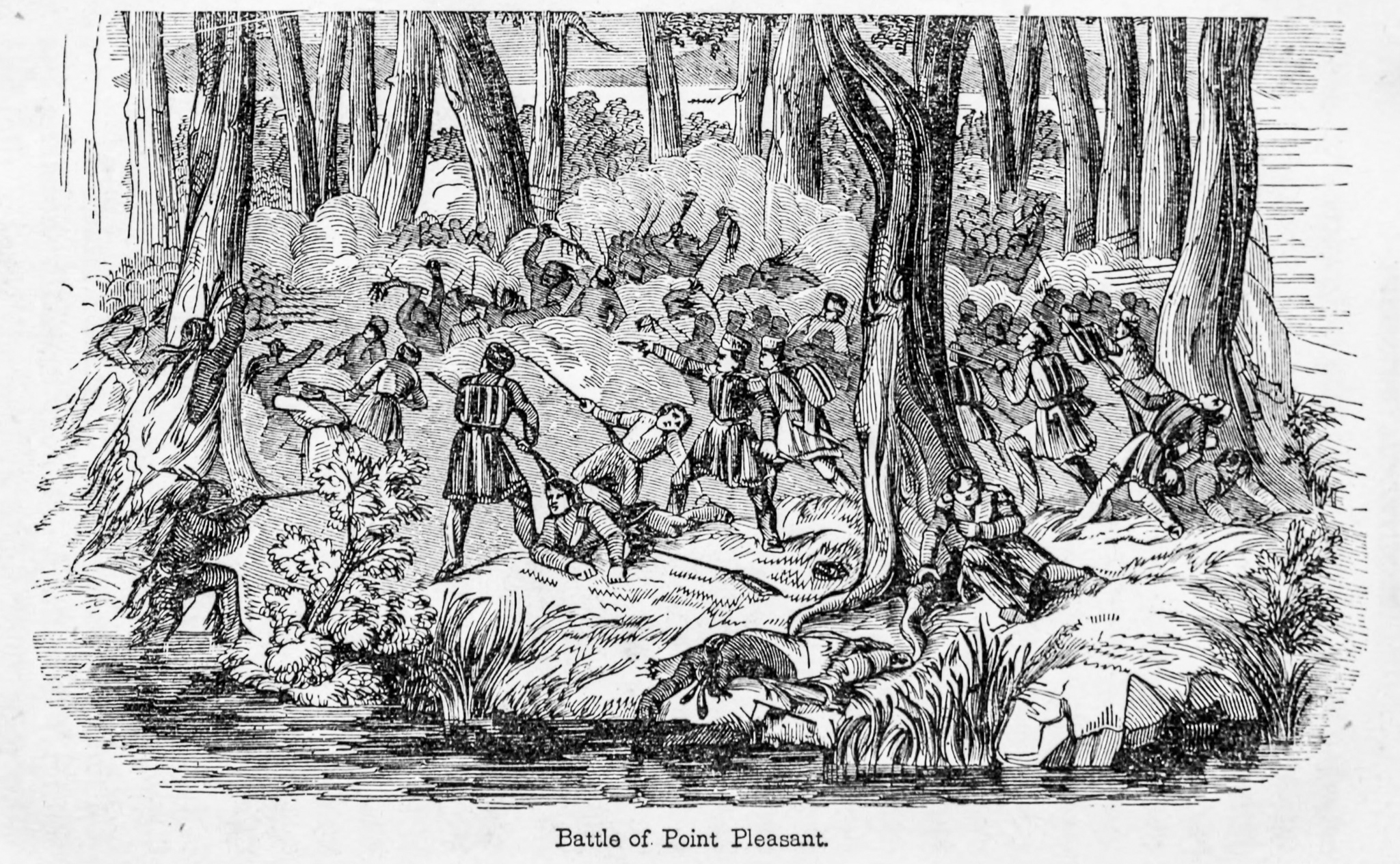
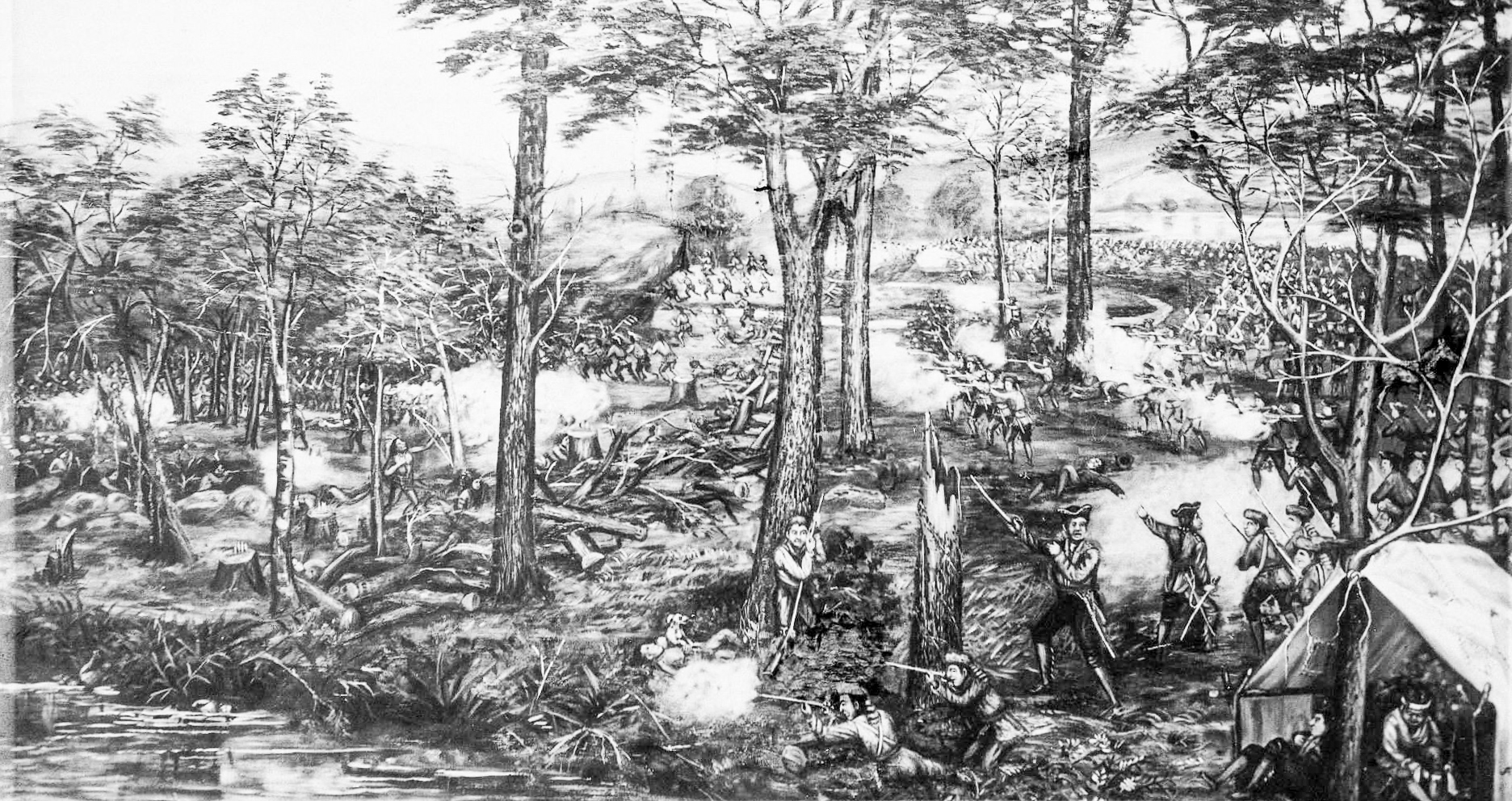
Fleming led his Botetourt men along the river while Lewis advanced inland with the Augusta troops. Conspicuous in his officer’s coat, Lewis made an easy target and was soon killed. His men fell back, and the weight of the attack swung onto Fleming’s line. Fleming was shot but managed to reach the rear and hand command to his second.
Battle of Point Pleasant by Joseph A. Faris, 1902
From dawn until nearly sunset the battle wore on. The flintlocks of the day were useless at any distance, so the fighting was close and often hand-to-hand.
By evening Cornstalk withdrew, leaving the field to the Virginians. The cost was heavy on both sides. The warriors carried off their dead, so their losses can only be estimated – perhaps 35 to 75. The militia counted 54 killed and 87 wounded, roughly one in eight, among them many of its leaders.
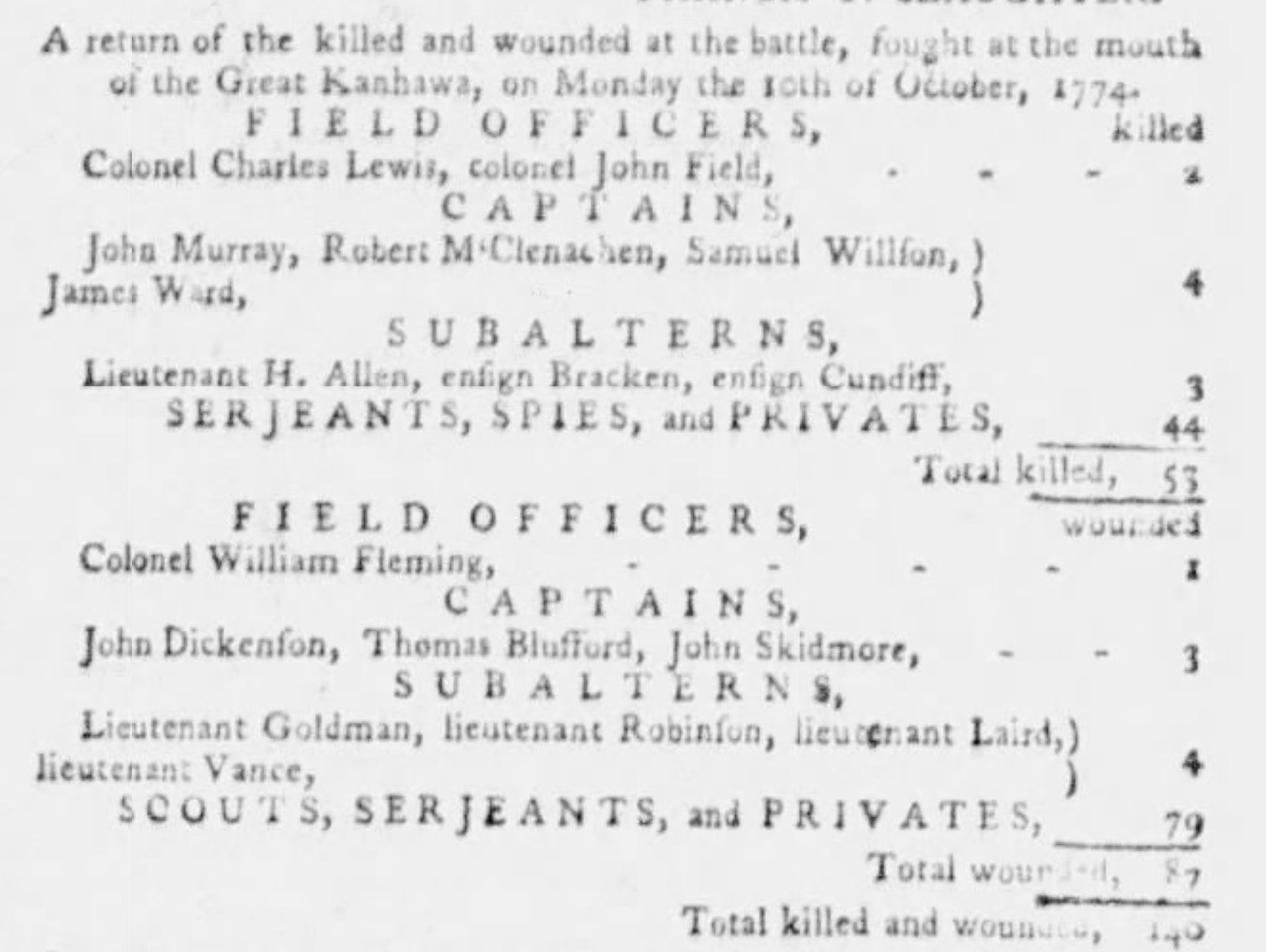
Among the dead was perhaps the oldest man on the battlefield – Captain James Ward. No first-hand account records my grandfather’s dying moments; family tradition says only that he was shot through the head. But he was not lost to the record: when the Virginia Gazette carried news of the battle that November, it named him among the four captains killed. His son William, at his side, had no time to grieve; as sergeant, he took command.
Clipping from Virginia Gazette, 10 November 1774
There was a third Ward on that field. A great uncle of mine. After the battle came reports of “white” Indians fighting among the Shawnee. One of them was White Wolf – the boy once called John Ward, taken 16 years before, now grown and fighting beside his adopted Shawnee family. Somewhere in the fog, a father and the son he had long mourned may have faced the same line. In an ironic twist, White Wolf, was killed by his brothers in 1793 in a skirmish with the Shawnee in present-day Ohio. That’s a story for another day.
It fell to William to carry the news home. His mother would have been overjoyed to see him, and devastated to learn she had lost her husband – left alone with seven children, the youngest only three. My fourth great-grandmother, Phoebe, was 13 when she lost her father. At 21, William took charge of the household. Phoebe went on to marry a Revolutionary War spy, my fourth great-grandfather, Silas Johnston. Like many Scotch-Irish of the time, they were drawn to the frontier. In 1802 Silas and Phoebe were among the first settlers moving into the Ohio country, on the eve of statehood.
Some say the Battle of Point Pleasant was the true beginning of the American Revolution. In fact, in 1908 the US Senate passed a bill calling it a battle of the Revolution – the House never agreed, but the idea stuck. Depends on your perspective, I guess. Some historians argue that, seen from the backcountry, the shots fired on the Ohio in 1774 – not those at Lexington six months later – marked its opening. Sure it was a campaign led by a British governor yet driven by men who had waited a decade in anger while the Crown ignored them. Their war was already a “declaration of independence.”
Regardless, most historians still date the American Revolution from those first shots at Lexington and Concord – and my own family helped fix it there. In 1837, my fifth cousin six times removed, Ralph Waldo Emerson, gave the North Bridge fight its immortal line: “the shot heard round the world.” So the poet who crowned Concord and the captain who fell on the Ohio six months before it hang from my same family tree. But for the families of the frontier – my Ward ancestors among them – the fight for their own future and liberty began with those shots in the morning fog at Point Pleasant.
Transcript of report in The Virginia Gazette Thu, Nov 10, 1774
Mr. PINKNEY,
I received yesterday, from my brother, by an express from the banks of the Ohio, at the mouth of Kanhaway [sic], an account of a battle between our troops and the Indians, which I have enclosed, to be inserted in your Gazette, with a list of the killed and wounded. My brother, likewise, writes me of our governor being still on his march to the Indian towns, and as the account is certain, he may not be expected for some time. His excellency was not in the engagement, being about 75 miles up the Ohio, on the Indian side. An express arrived from him the evening after the battle, with orders for their troops to meet him at some distance from the towns, so that when this express came off he had no account of the battle.
I am, Sir, your obedient servant,
FRANCIS T. SLAUGHTER.
A return of the killed and wounded at the battle, fought at the mouth of the Great Kanhawa, on Monday, the 10th of October, 1774:
Killed — Field officers (2): Colonel Charles Lewis, Colonel John Field. Captains (4): John Murray, Robert M’Clenachen, Samuel Willson, James Ward. Subalterns (3): Lieut. H. Allen, Ensign Bracken, Ensign Cundiff. Serjeants, spies, and privates: 44. Total killed, 53.
Wounded — Field officers (1): Colonel William Fleming. Captains (3): John Dickenson, Thomas Bufford, John Skidmore. Subalterns (4): Lieut. Goldman, Lieut. Robinson, Lieut. Laird, Lieut. Vance. Scouts, serjeants, and privates: 79. Total wounded, 87. Total killed and wounded, 140.
From the Camp, on Point Pleasant, at the mouth of the Great Kanhawa, October 17, 1774.
“For the satisfaction of the public, in this letter they have a true state of the battle fought at this place on the 10th instant: On Monday morning, about half an hour before sunrise, two of captain Russell’s company discovered a large party of Indians about a mile from camp; one of which men was shot down by the Indians, the other made his escape and brought in the intelligence. In two or three minutes after, two of captain Shelby’s came in and confirmed the account. Colonel Andrew Lewis, being informed thereof, immediately ordered out colonel Charles Lewis to take the command of 150 of the Augusta troops; and with him went captain Dickenson, captain Harrison, captain Willson, captain John Lewis of Augusta, and captain Lockridge, which made the first division. Colonel Fleming was also ordered to take the command of 150 more of the Botetourt, Bedford, and Fincastle troops, viz. captain Thomas Buford from Bedford, captain Love of Botetourt, captain Shelby, and captain Russell of Fincastle, which made the second division. Colonel Charles Lewis’s division marched to the right, some distance from the Ohio, and colonel Fleming, with his division, on the bank of the Ohio, to the left. Colonel Charles Lewis’s division had not marched quite half a mile from camp when, about sunrise, an attack was made on the front of his division, in a most vigorous manner, by the united tribes of Indians — Shawanese, Delawares, Mingoes, Tawas, and of several other nations — in number not less than 800, and by many thought to be 1000. In this heavy attack colonel Charles Lewis received a wound which in a few hours caused his death, and several of his men fell on the spot; in fact, the Augusta division was forced to give way to the heavy fire of the enemy. In about a second of a minute after the attack on colonel Lewis’s division, the enemy engaged the front of colonel Fleming’s division on the Ohio, and in a short time the colonel received two balls through his left arm and one through his breast; and after animating the officers and soldiers in a most calm manner to the pursuit of victory, retired to the camp. The loss from the field was sensibly felt by the officers in particular; but the Augusta troops being shortly reinforced from the camp by colonel Field with his company, together with captain M’Dowell, captain Matthews, and captain Stewart from Augusta, captain John Lewis, captain Paulin, captain Arbuckle, and captain M’Clenachan from Botetourt, the enemy, no longer able to maintain their ground, was forced to give way till they were in a line with the troops — colonel Fleming being left in action on the bank of the Ohio. In this precipitate retreat colonel Field was killed. During this time, which was till after 12 o’clock, the action continued extremely hot. The close under-wood, many steep banks, and logs greatly favoured their retreat; and the bravest of their men made the best use of them, whilst others were throwing their dead into the Ohio and carrying off their wounded. After 12, the action in a small degree abated, but continued, except at short intervals, sharp enough till after one o’clock. Their long retreat gave them a most advantageous spot of ground, from whence it appeared to the officers so difficult to dislodge them that it was thought most advisable to stand as the line was then formed, which was about a mile and a quarter in length, and had sustained till then a constant and equal weight of the action, from wing to wing. It was till about half an hour of sun-set they continued firing on us — scattering shots, which we returned to their disadvantage. At length, night coming on, they found a safe retreat. They had not the satisfaction of carrying off any of our mens scalps, save one or two stragglers whom they killed before the engagement. Many of their dead they scalped, rather than we should have them; but our troops scalped upwards of twenty of their men that were first killed. It is beyond doubt their loss in number far exceeds ours, which is considerable.”