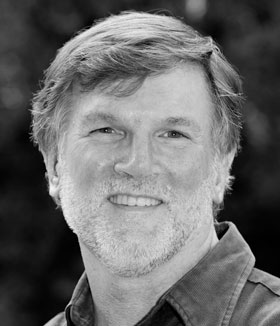
Michael Webert, 1843–1904
PROLOGUE: A CORNFIELD IN DUNN COUNTY
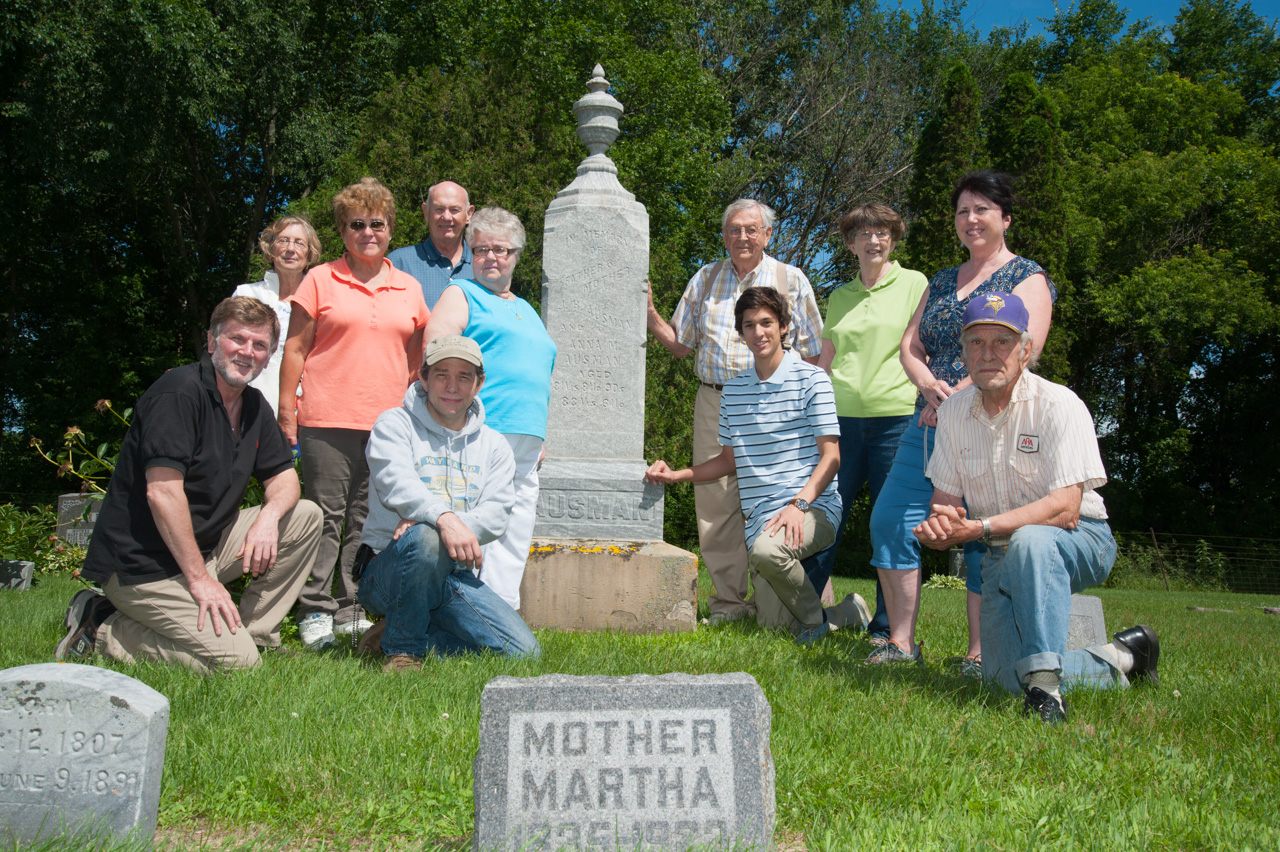
In July 2014 I drove to Elk Mound, Wisconsin, with my son Joseph, my mother, and a carload of cousins I’d until then mostly known only as names on a family tree.
I was born in Southern California and didn’t move to Wisconsin until I was ten, and I never quite shook the feeling of being a foreigner there. It’s probably why I left after university and spent most of my adult life somewhere else. What I didn’t understand at the time was how deep my roots ran in that particular ground – that some of northern Wisconsin’s original homesteaders were mine.
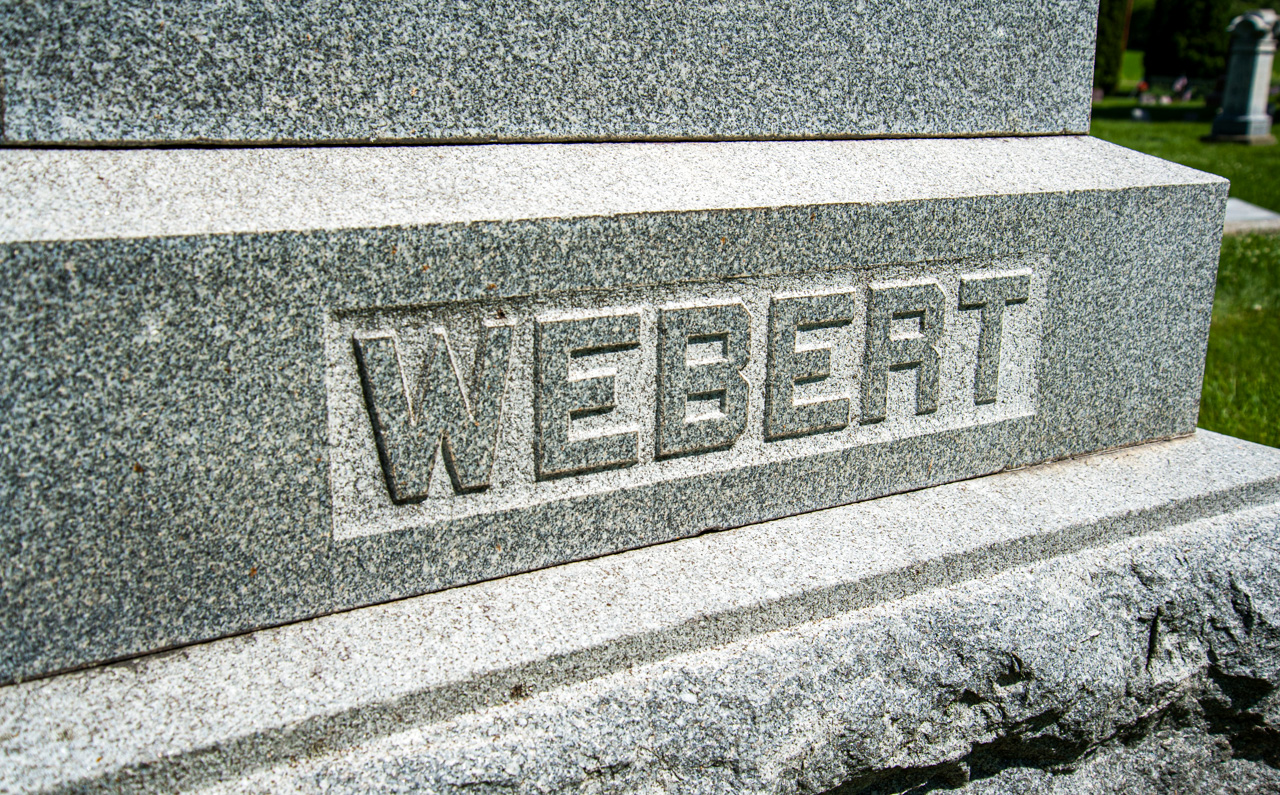
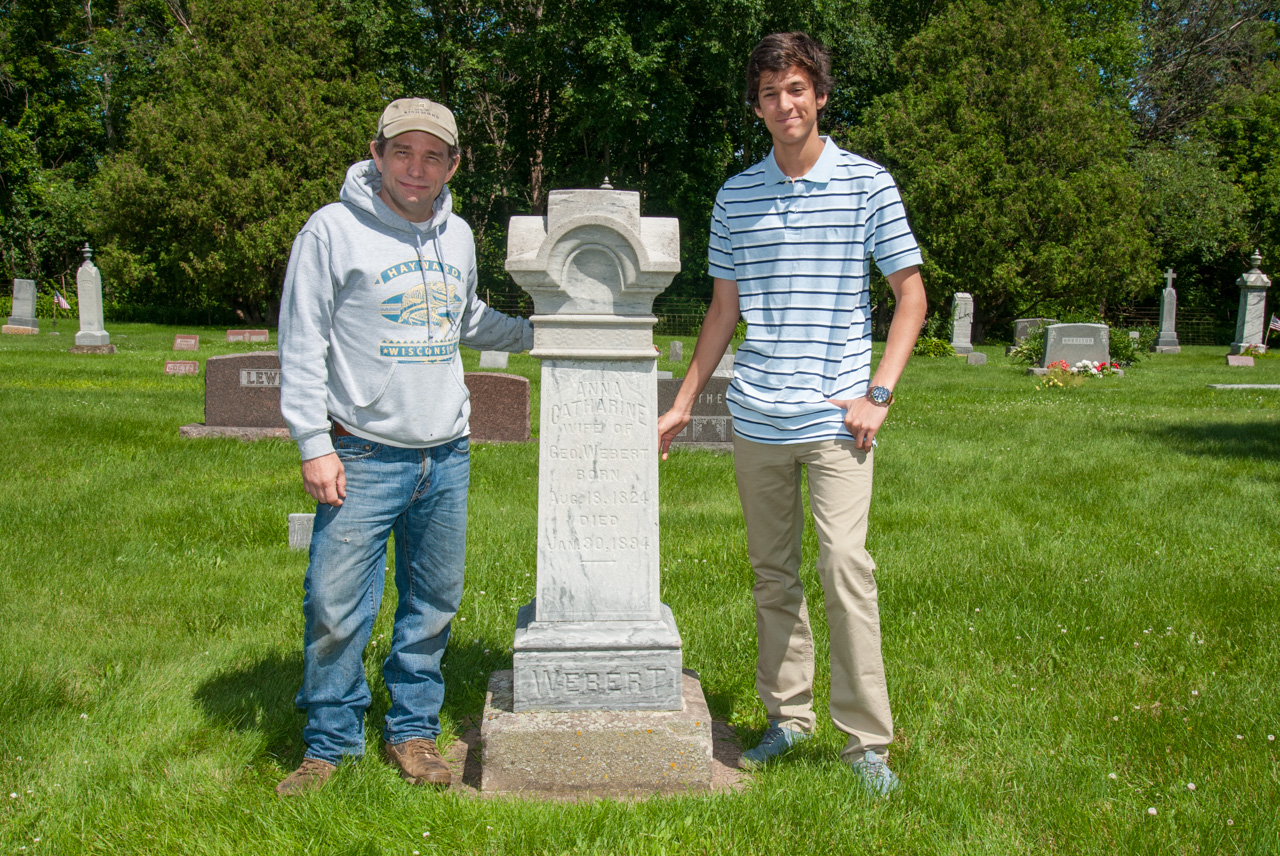
We made a day of it. We stood around a headstone in Evergreen Cemetery at Elk Mound, where a good many of my kin lie. Danny Goetz was there, who’d been helping me untangle the Webert line by email for ten years and whom I met in the flesh for the first time that morning. So was LaVerne Ausman, who’s farmed at Elk Mound his whole life and once ran Wisconsin’s agriculture department. So was Donald Goetz, eighty-five years old, who grew up in the district in the thirties and told us what it had been like.
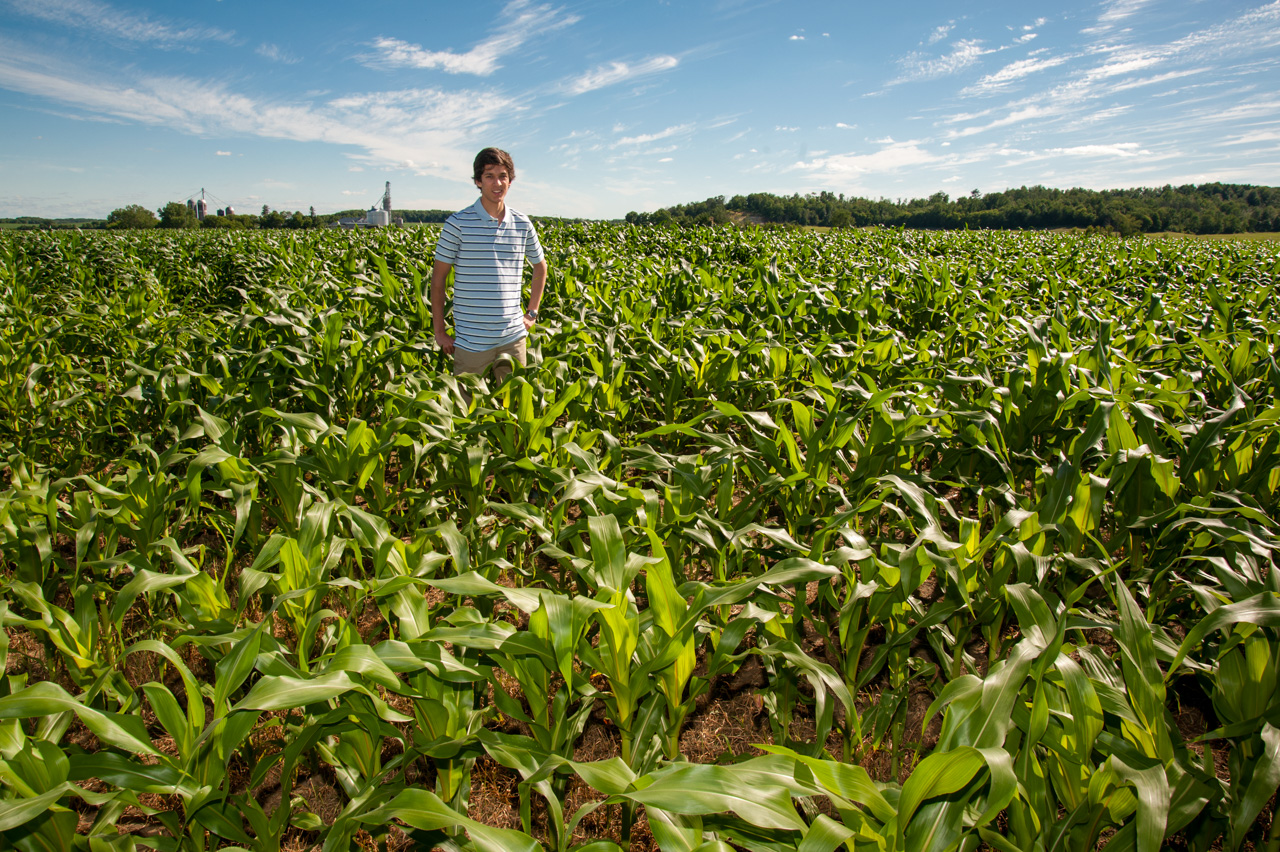
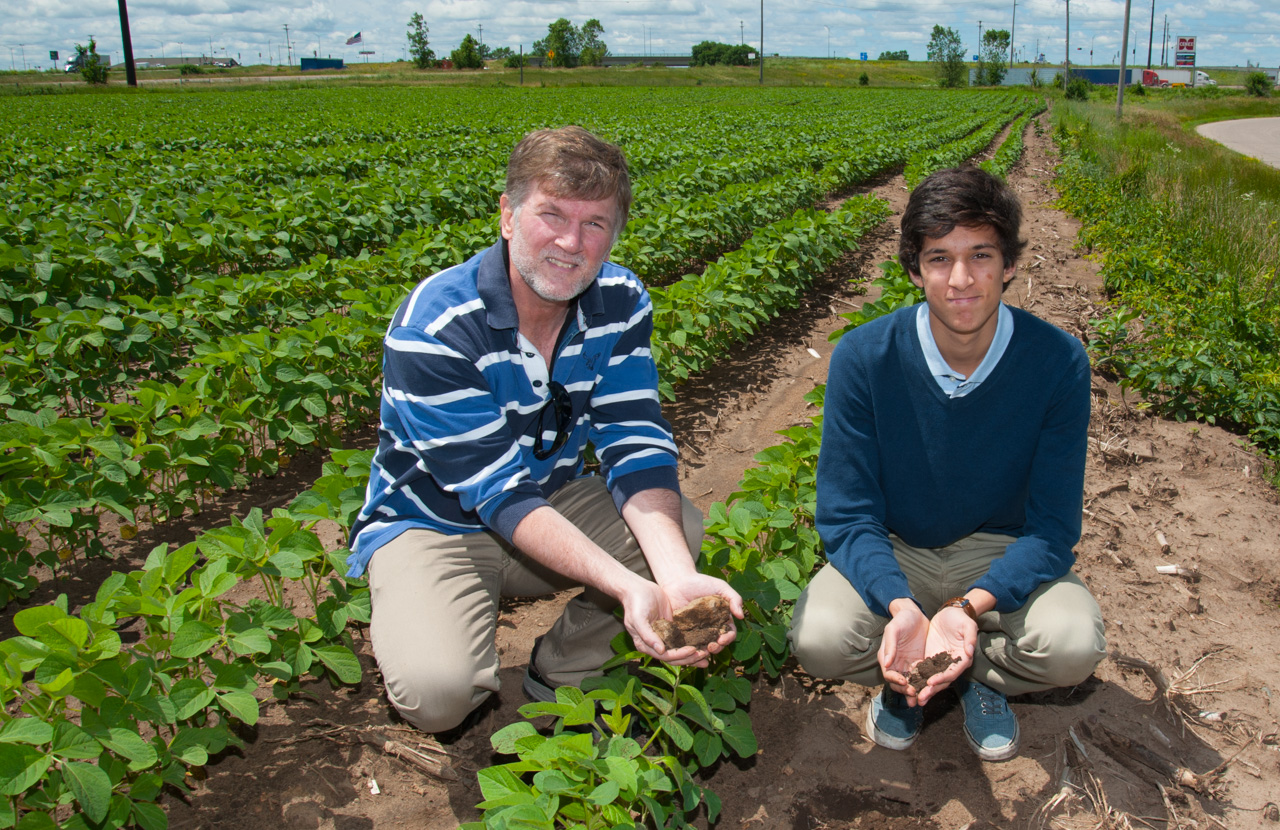
Late in the day, driving past one cornfield after another, Joseph said he’d never once stood in a cornfield.
So we stopped. And it seemed only right that the first cornfield my son ever stood in should be the one his great-great-great-grandfather made.
Because that’s what it is. When Michael Webert first walked onto those eighty acres in the 1870s, they weren’t a field. They were oak and maple and pine. Every foot of that open ground was made by hand – with an axe, a crosscut saw, a chain and a team – by one man and whoever he could get to help him, and it took him years.
I took the photograph: my son standing in young corn on a bright afternoon, a bit north of the Elk Mound village. And then I stood at the edge of the road looking at him and realised I couldn’t have told him much about the man who cleared it.
So I started to learn more about the man that cleared that field.
I. OLBERODE
Michael Webert was born on 8 November 1843 in Olberode, a German farming village folded into the head of a small valley in the Knüll hills of northern Hesse. It’s lovely country and hard country at once — wooded ridges rising to five and six hundred metres, thin stony soils, long winters, and a lot of walking between one place and the next. Bad Hersfeld was twenty kilometres east. Kassel, where the Elector lived, was a good day beyond that.
The village was already old when Michael was born. It turns up in writing in 1364, and the ancient trade road between Cologne and Leipzig ran straight through it.
Michael was born a subject of the Elector of Hesse. The village was Protestant and had no parish of its own; it was a daughter church of Oberaula, and that’s where his baptism was written into the register.1
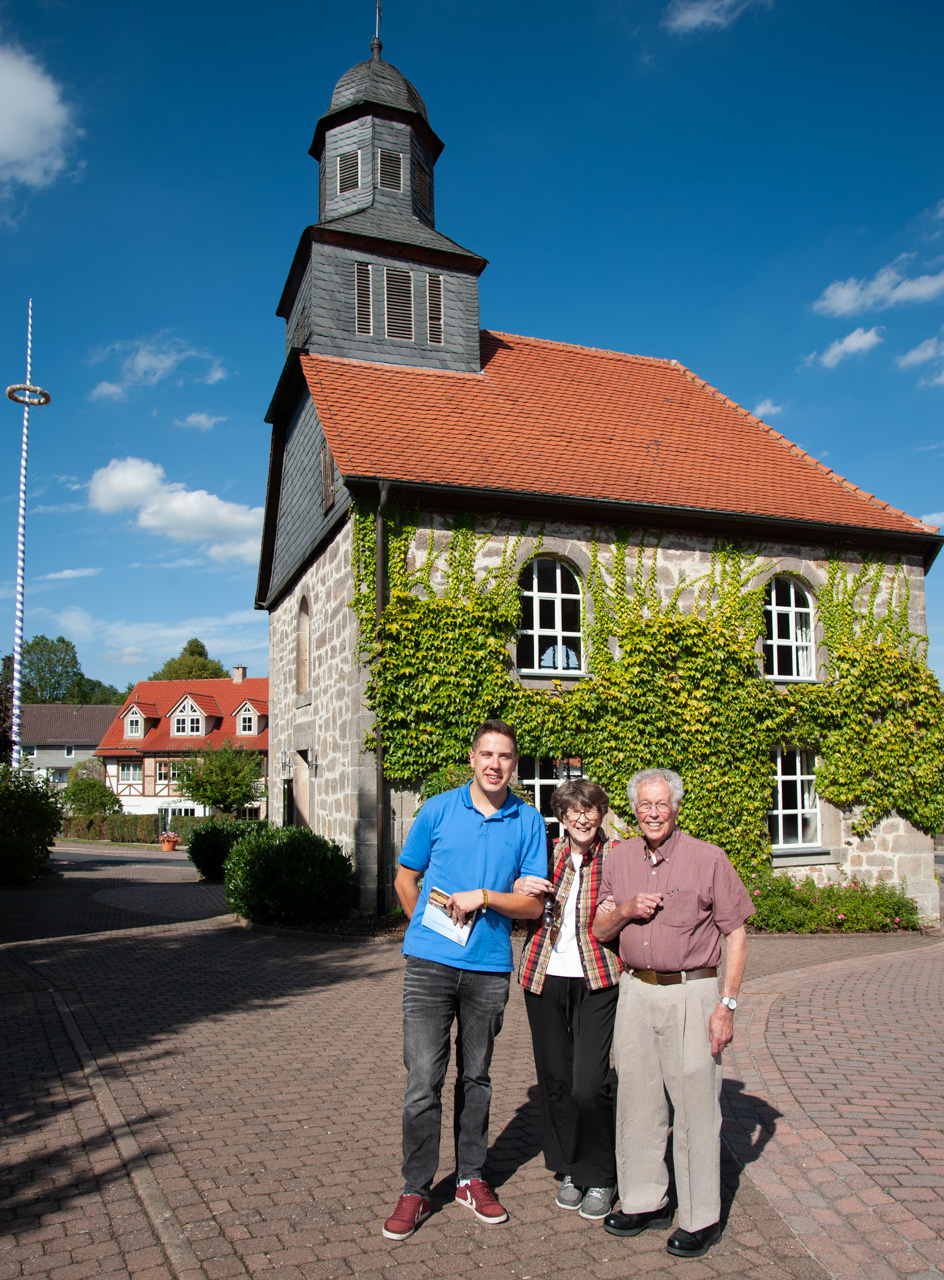
I’ve stood in that church.
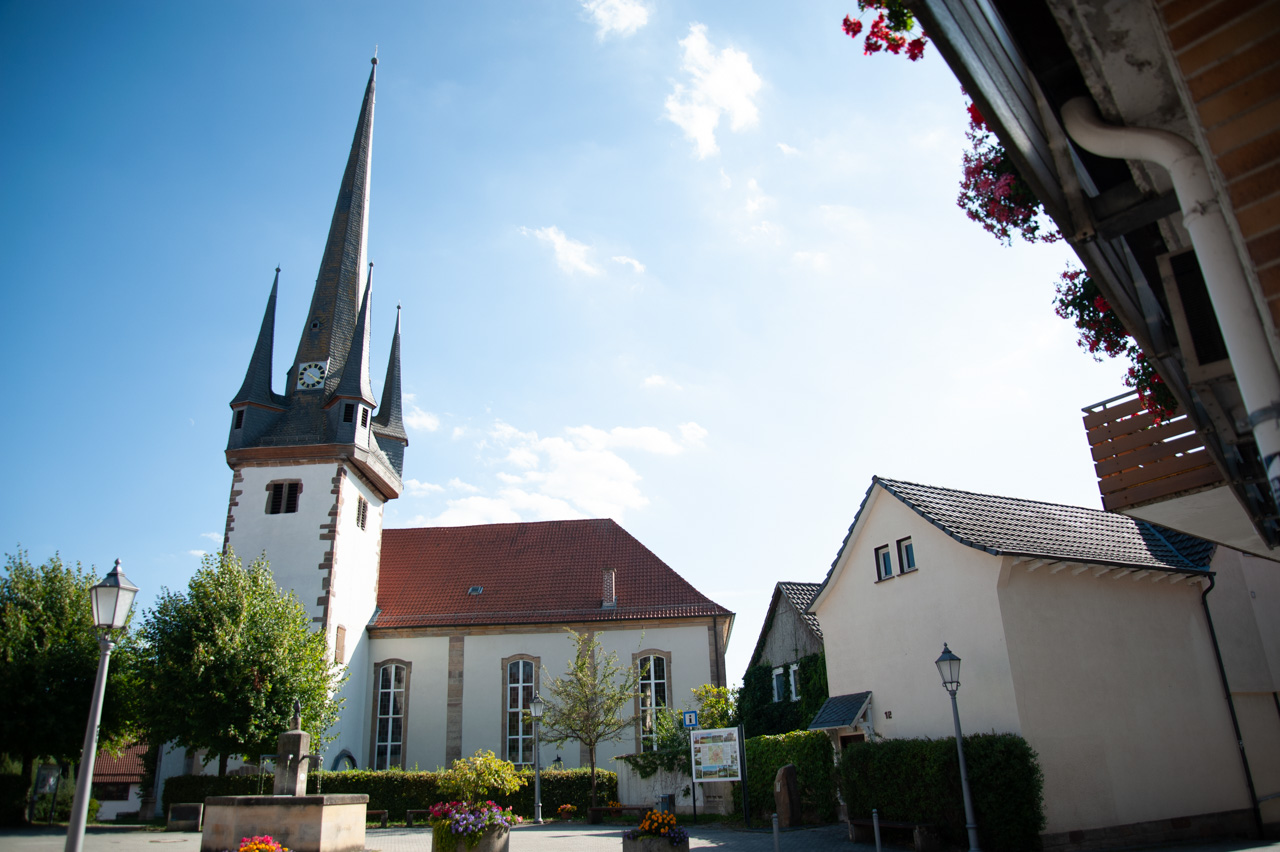
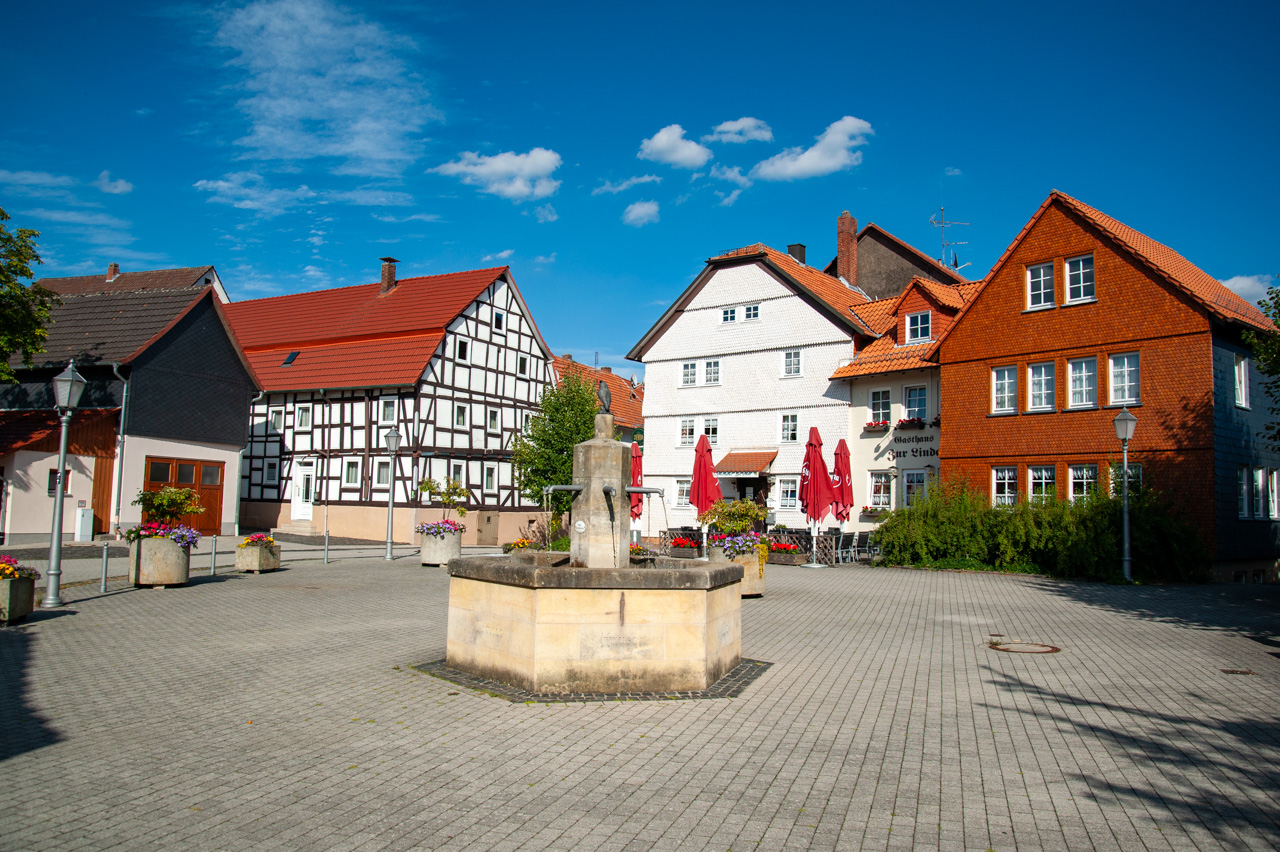
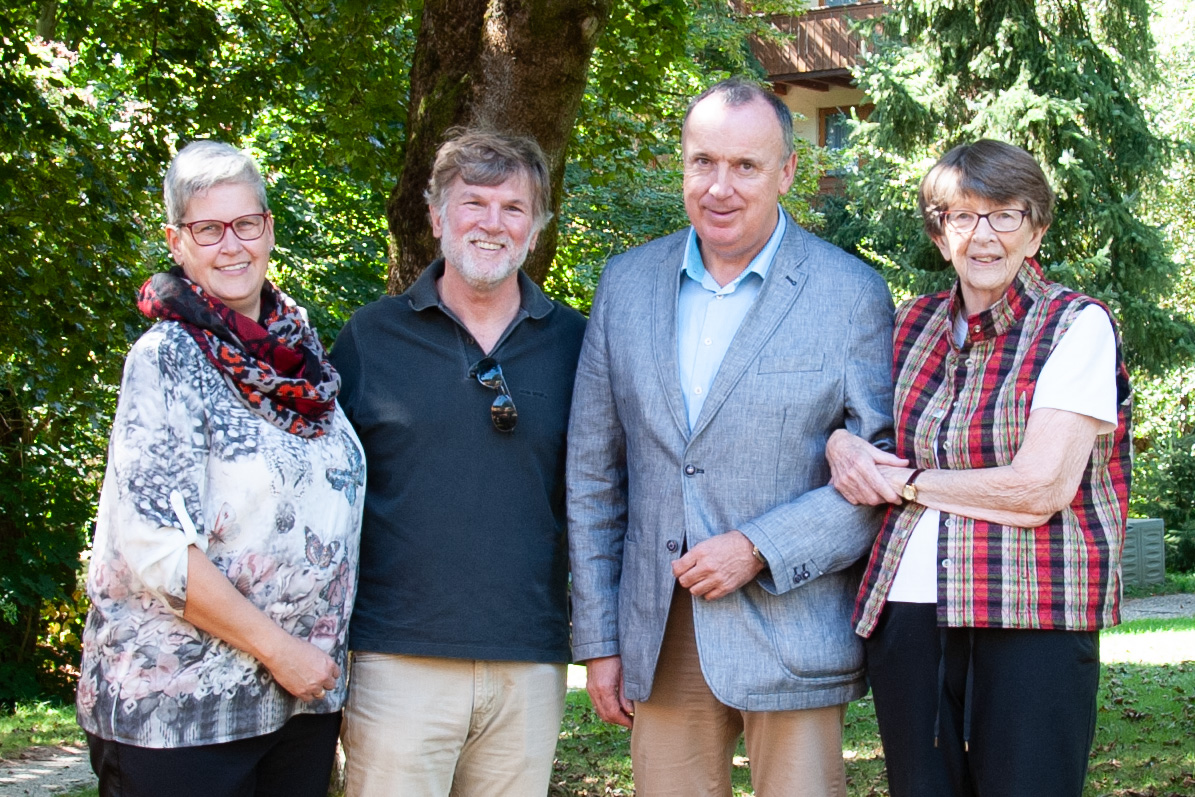
In September 2019 my mother and I went to Olberode — Mom, whose maiden name is Webert, and who for most of her life knew about as much as I did, which was nothing. We were met at Oberaula by Ulrike, a local family historian who’d been feeding me information for years, and by her son Patrik, and then, before we’d even shaken hands, by the mayor of Oberaula himself, Herr Klaus Wagner, who takes a personal interest in the families that left his district and wanted to know what had become of the Weberts. Ulrike spread out a family tree that ran back to my fifth great-grandfather, Abel Webert, born a few minutes’ walk from where we were sitting in 1742.
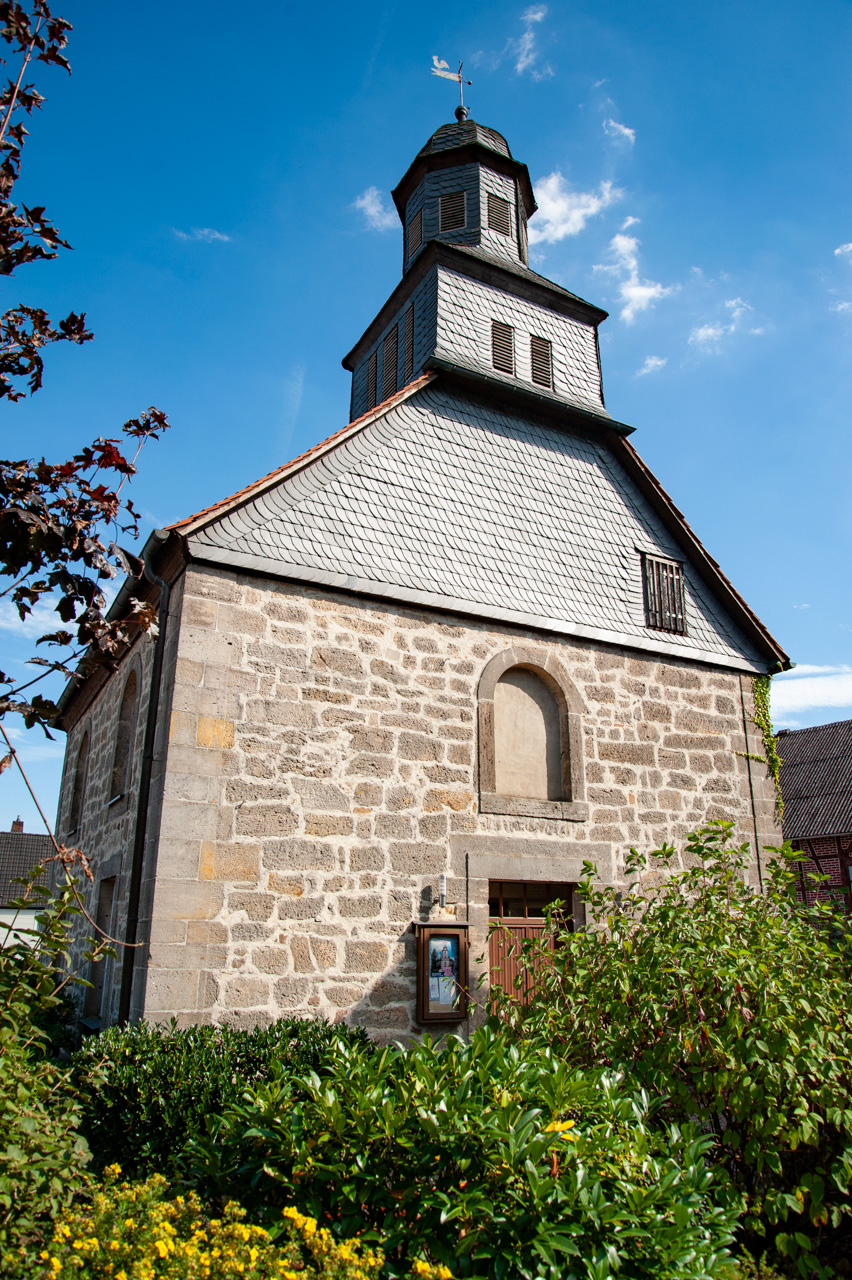
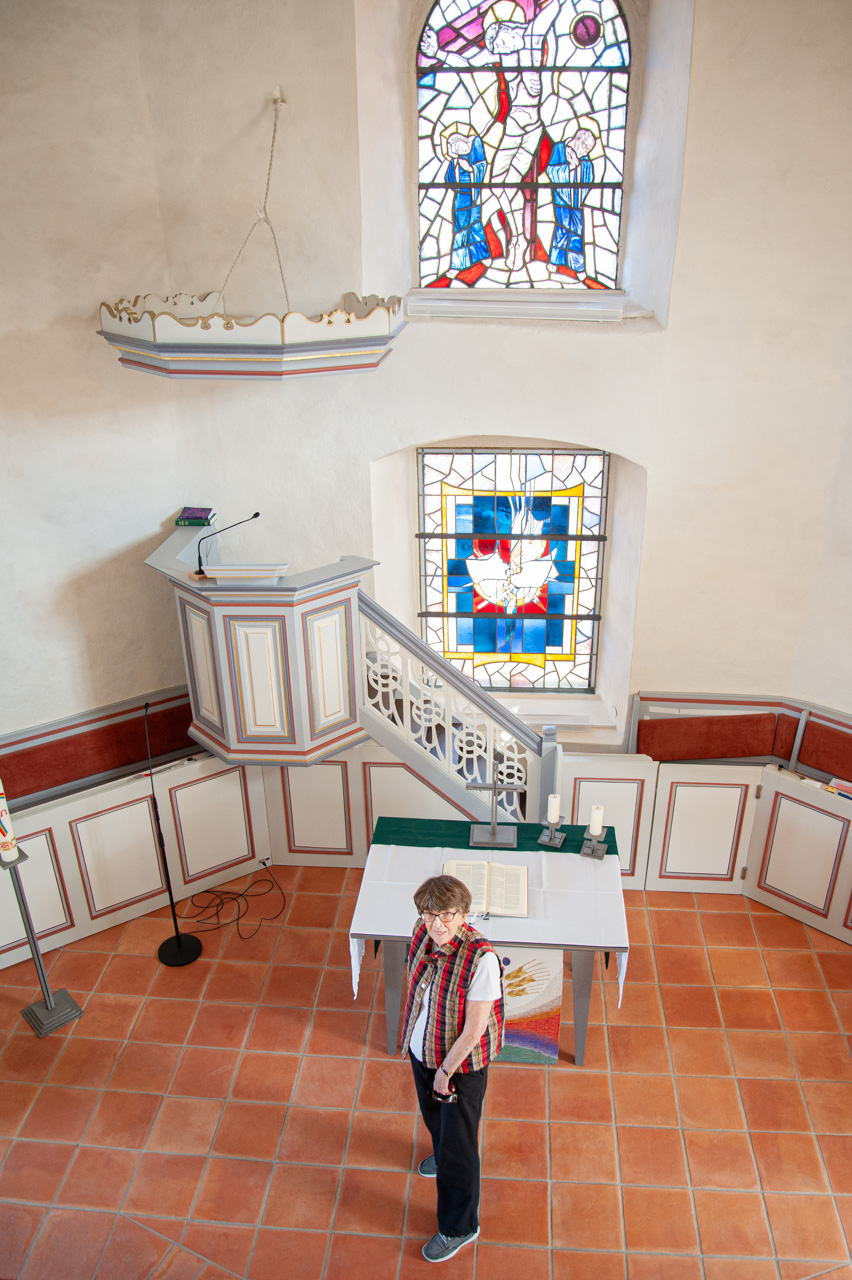
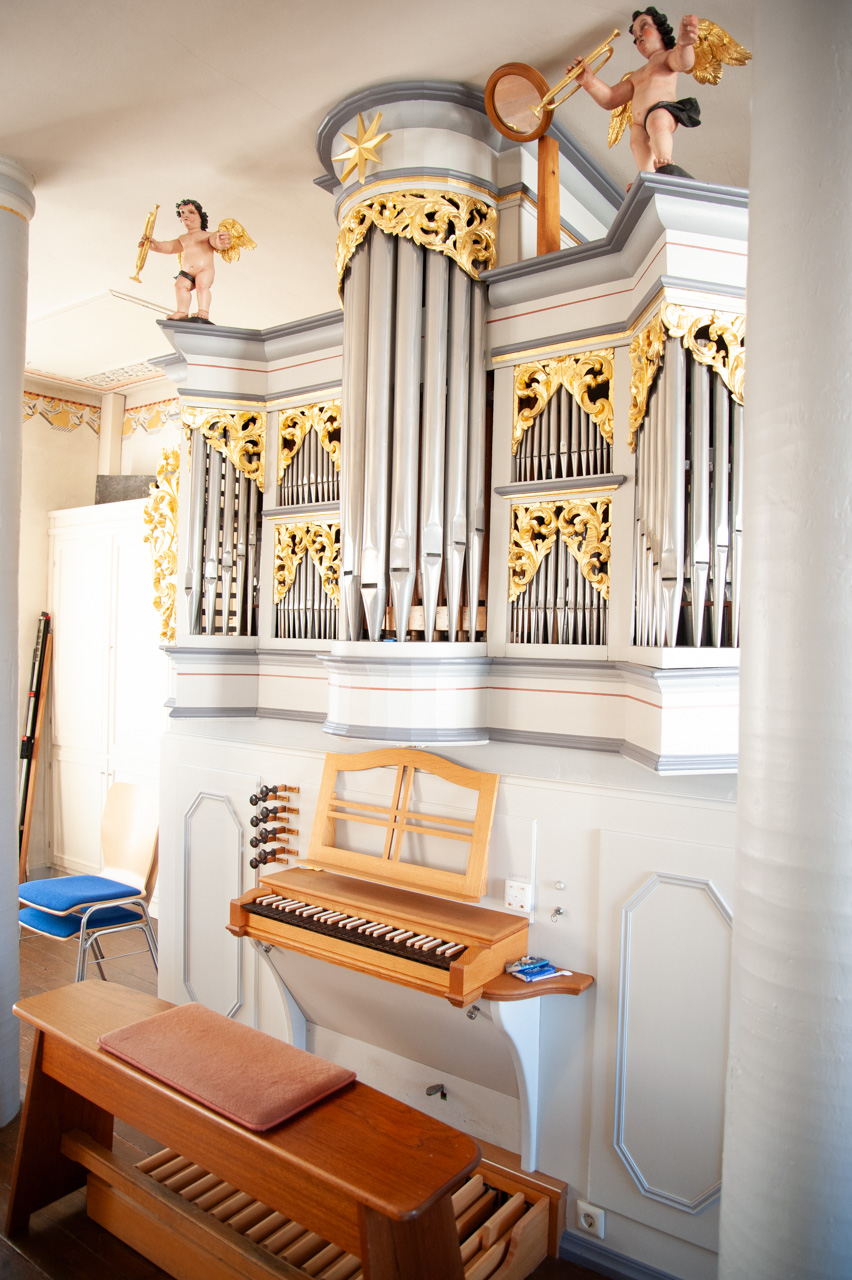
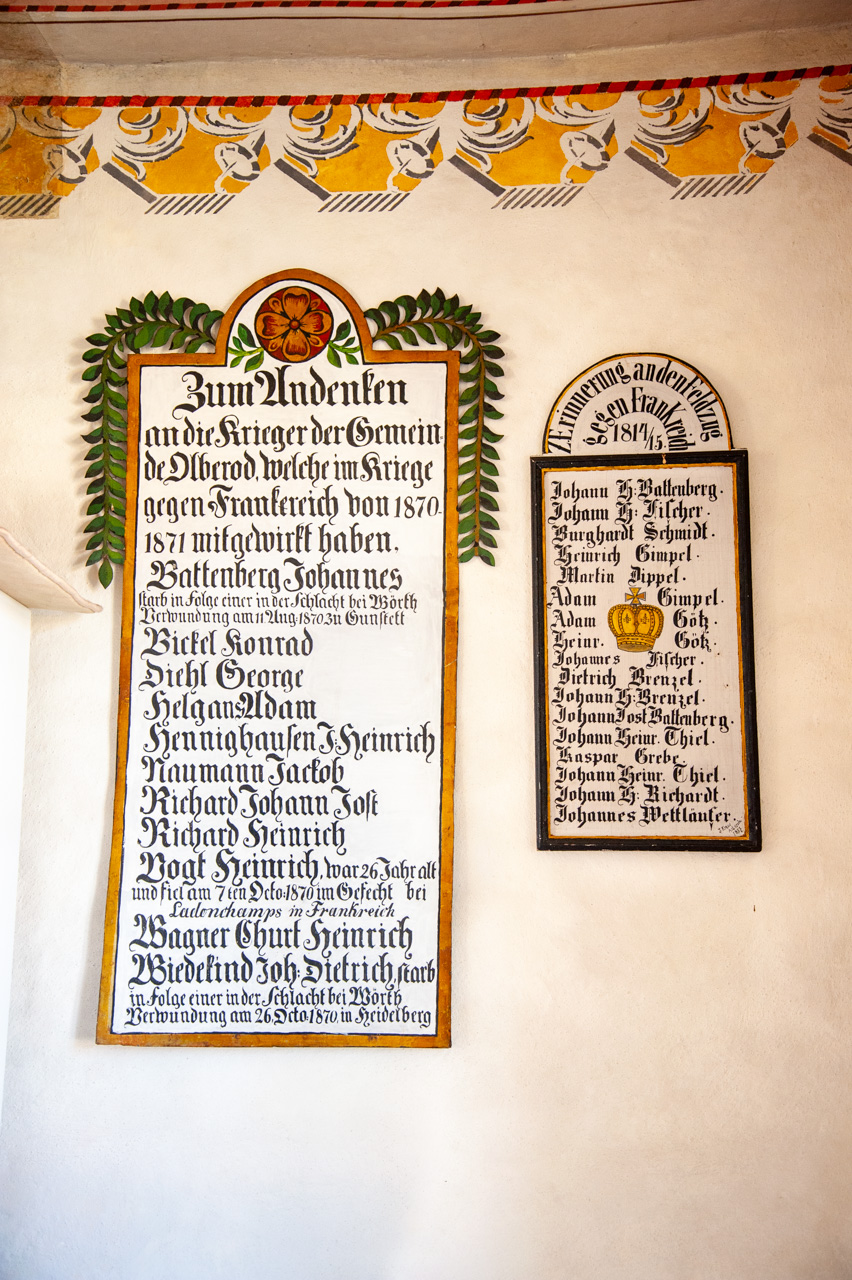
Then Patrik and Uli drove us the short way out to Olberode, and we went into the church where my family were christened and married for generations.
Afterwards Uli took us across the road. Here’s where your ancestor lived, she said. I looked at a patch of weeds beside an old farm building. There’s nothing left of the house of my fourth great-grandfather, Johann Adam Goetz. But the church is twenty metres away, and standing there I could see the whole thing — the Goetz family and the Webert family coming out their doors on a Sunday morning and walking that little distance together.
Magdalena Webert never left. Her descendants are still in the district.
Up until that afternoon, Wisconsin was where my family came from. After it, Wisconsin was where my family went.
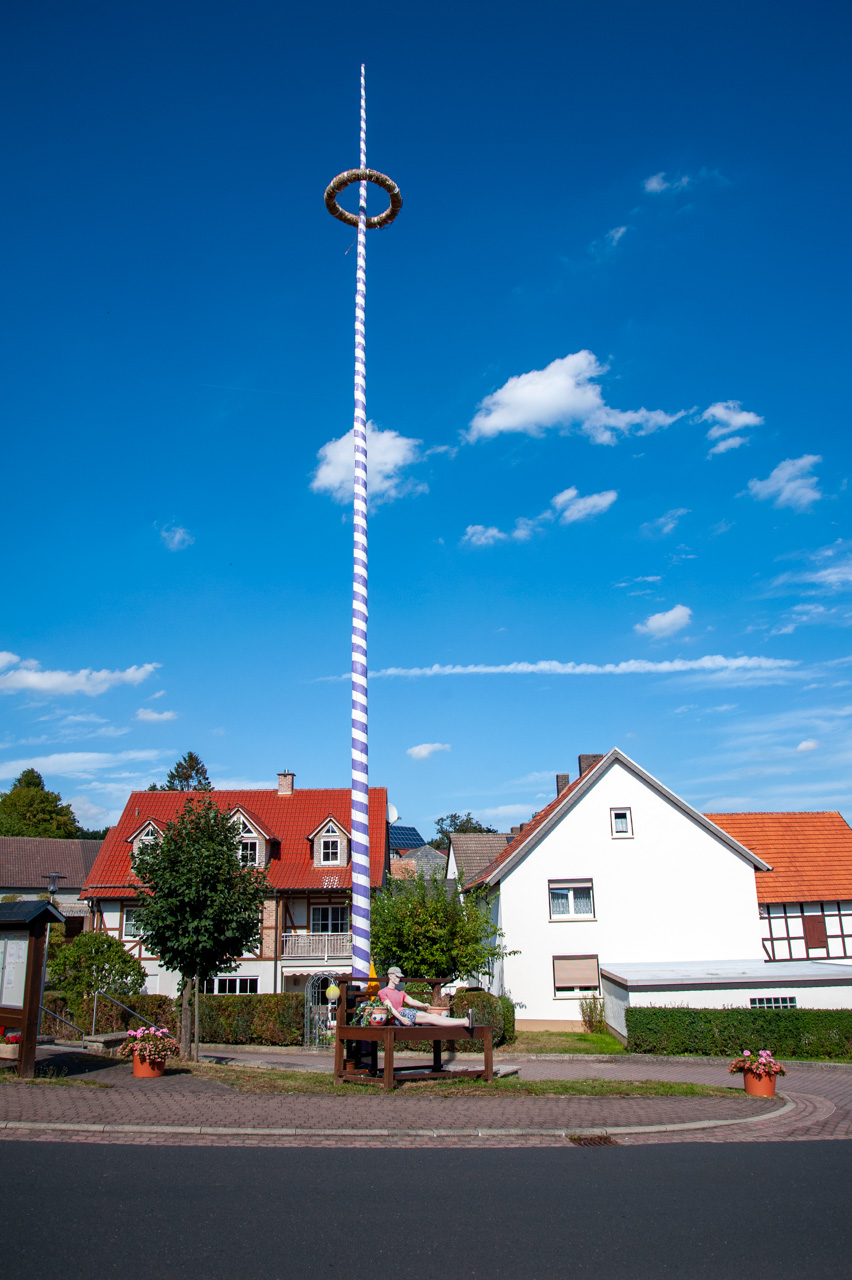
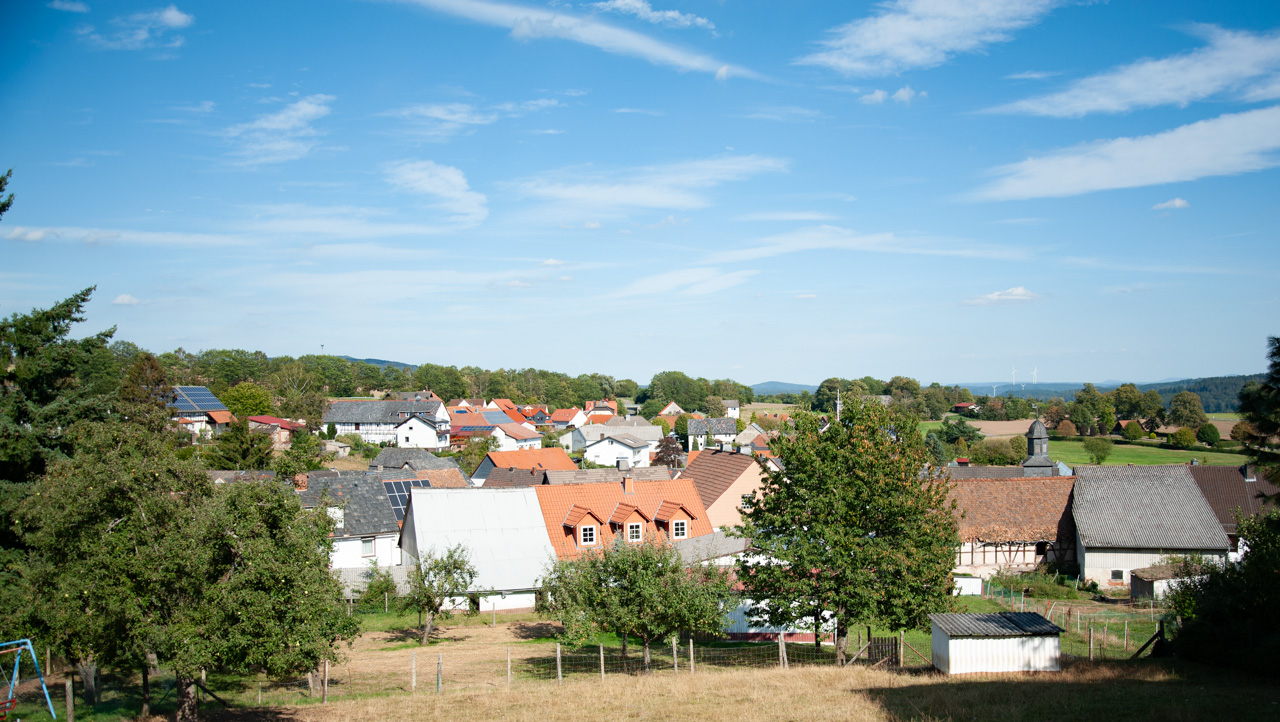
Nearly everyone there farmed, and nearly everyone did something else as well, because farming alone wouldn’t keep a family fed. A survey of the next village along counted two blacksmiths, a wheelwright, a joiner, two masons, a cooper, a tailor, three millers, a shopkeeper and four linen weavers — and the clerk noted, almost as an afterthought, that the weavers were farmers too.2
His father wasn’t at the bottom of that world. George August Webert was an Ackermann, and that’s a specific word. It meant a man with a full holding, his own plough and his own team — the top rank of the village peasantry, well clear of the cottagers and a long way clear of the day labourers. He was twenty-four. Anna Catharine Goetz was nineteen, born in the same village on 18 August 1824.3
Michael was their first child, and ten more came after him.
Three of those children didn’t live. Henry, Maria and Conrad all died as infants between 1851 and 1856, when Michael was somewhere between seven and twelve. Old enough to remember every one of them.
It needs saying plainly that this wasn’t unusual. It was ordinary, and that’s worse. In their district in those years roughly one baby in five died before its first birthday — and that was one of the better parts of Germany.4 Summer diarrhoea killed infants who weren’t breastfed. Farm women were labour before they were mothers, and at harvest they were labour first. Smallpox and measles and whooping cough and typhus moved through villages unchecked, with no antibiotics, no vaccination worth the name, and no understanding of germs.
And there was hunger. The years those three babies died sit squarely inside Germany’s last great food crisis — grain prices climbing through the early 1850s and spiking hard in 1854, with the Crimean War shutting off Russian and French exports. By 1855 the German birth rate itself was falling.5 A hungry mother makes less milk. Three infant deaths in five years, in the worst food years of the century, isn’t bad luck. It’s a national crisis turning up in one family’s parish register.
II. WHY PEOPLE LEFT OLBERODE
The village has kept its own account of what happened next, and it’s blunt about it.
By the middle of the century the economic situation was bad for most people in the district, and worst for the smallholders and the day labourers. Crop failures meant people went hungry. There was no industry. Village handicraft didn’t provide enough work. For a lot of families the only way to survive was to leave, and where they went was America. It was mainly the smallest farmers and the landless — the ones with nothing to lose. They had to get the government’s permission first, and after they’d survived the crossing they arrived with next to nothing, because sickness from poor hygiene and plain hunger were routine aboard the ships.
Between 1852 and 1883, sixty-two people left Olberode for America.6
Sixty-two, out of a village of a few hundred. And that wasn’t the start of it either — back in 1837 several Olberode families had pulled up and gone to Poland.
Here’s the thing, though. The Weberts don’t fit that description. George was an Ackermann, not a cottager and not a day labourer. He had land and a team. He wasn’t one of the desperate.
So why did he go?
III. ANNA’S FATHER GOES FIRST
In 1853, when Michael was nine, his mother’s father sold up and left for America.
Johann Adam Goetz had been born at Olberode in 1786, and by 1853 he was sixty-seven years old. His son Heinrich, then twenty, went with him.7
Hold that image, because it’s the hinge of this whole story. Not a young man chasing land — a grandfather in his late sixties, walking away from the village he was born in, crossing an ocean, and buying forty acres in a country he’d never seen.
He didn’t go to the frontier, not at first. He went to Washington County in south-eastern Wisconsin, the settled German belt north-west of Milwaukee, and farmed there through the fifties, living for a time in the household of his daughter Anna Katharina and her Paff family. Only afterwards did the Goetzes push north-west into newly opened country. Johann Adam died at Sigel, in Chippewa County, in 1861 — about eight years after he arrived, and four years before his daughter Anna ever set foot in America.
She’d last seen her father when she was in her twenties with small children at her skirts. By the time she got to his country he was in the ground at Chippewa.
His other children followed the same road. His son John went. His daughter Anna Maria and her husband Jacob Diebel, a mason, are down as leaving in 1861. Anna Katharina and the Paffs were already there.
And here’s the asymmetry that shapes everything after it. George Webert had nobody waiting. He had one sister, Magdalena, and she stayed in Olberode all her life and died there. Not one Webert relative ever followed him across. Every single kinsman that family had in America was Anna’s.
So what happened in 1865 wasn’t really a Webert emigration at all. It was the Goetz family of Olberode transplanting itself to Wisconsin across two generations — and George Webert going with his wife to her people, leaving his only sister behind for good.
IV. THE YEAR THEY LEFT
By the 1860s the pressure had built up on every side.
The deepest problem was land. Hesse-Kassel sat right on the border between two inheritance customs — the northern one, where a single heir took the whole farm, and the south-western one, where the land got split among all the children until the strips were too small to feed anybody. Neither had a good answer for a family with eight surviving children. If you were a younger son where the farm passed whole, you were a labourer for life. If you were where it got divided, your share wouldn’t keep you.8
Then the wider market: cheap American wheat had begun dragging world grain prices down. Then Kurhessen itself, a state whose long quarrel between Elector and parliament had blown up in 1850, when 241 of the Elector’s 257 army officers resigned rather than break their oath to the constitution, leaving him to call in Bavarian and Austrian troops to restore his authority.9 Everyone could see Prussia coming, and Prussia duly arrived in 1866.
And America had just reopened. Emigration had slowed to a trickle during the Civil War and picked up the moment it stopped.
So in October 1865, George and Anna Webert sailed from Bremen for New York on the steamer America, with seven children.
Getting there took some doing, though less than it would have a generation earlier. There was no railway in the Knüll, so the first stage was on foot or by cart, most likely west to Treysa, twenty-five kilometres off, which had been on the Main-Weser line since 1850. From Treysa the rails ran north to Kassel, from Kassel through Göttingen to Hannover, and from Hannover to Bremen. Bremen had made itself the emigrants’ port on purpose — opening Bremerhaven in 1830, and passing in 1832 the first law anywhere in Germany regulating emigrant sea passage.10
They landed at New York on 9 November 1865 and went straight to Chippewa County, where Anna’s brothers were. They settled first in the Town of Sigel, and two years later moved west to Elk Mound in Dunn County.11
Michael didn’t go with them.
V. THE ONE WHO STAYED
He was twenty-one, the eldest son, and by every reasonable reading he stayed behind because he was a soldier.
I have to be honest here: no record of his service has ever turned up. This is an inference. But it’s a strong one, and it rests on more than family memory. Michael turned twenty in November 1863, which is exactly the age at which young Hessian men were called up. And there’s a hard legal reason he couldn’t have gone. Emigration from Kurhessen needed the state’s permission — a formal release from the Untertanenverband, the bond of subjecthood — and a man of military age had to show his obligation discharged before he’d get it. Whatever else kept Michael in Hesse in October 1865, the law would have.12
The army he served was the Elector’s, not Prussia’s. Family memory has sometimes called it a Prussian regiment, and it’s an easy mistake, but Prussia didn’t take Kurhessen until the summer of 1866. In 1865 there was still a Kurfürstlich Hessische Armee of about nine thousand men. Men were taken by lottery, and a man whose number came up could name a substitute to serve for a fee — which meant the burden landed exactly where there was no money to buy a way out. The term was four years with the colours and one in reserve.13
Family tradition says he was discharged and allowed to follow. That’s entirely plausible. Whether the paper survives is another matter — only about half the people who actually left Kurhessen ever show up in the emigration files at all.
VI. THE CROSSING
We don’t know the day Michael arrived in America, or the ship that brought him.
And here’s why we probably never will. Bremen’s emigration officials, short of shelf space, started destroying their passenger lists in the 1870s and kept at it for decades. Everything from 1832 to 1872 was burnt.
The record of Michael Webert leaving for America hasn’t been mislaid. It doesn’t exist.
What we can say is that he almost certainly landed at New York, because that’s the road his family had already proved. Which means that somewhere in the late 1860s he walked into Castle Garden — a round sandstone fort at the tip of Manhattan, built for the War of 1812, later a concert hall where Jenny Lind sang, and from 1855 the first organised immigration station in the country. Ellis Island didn’t open until 1892.
Inside there was a system. Arrivals were checked against the ship’s list, then taken into the great circular rotunda where their name, nationality, former residence and intended destination were written down. There was a money exchange, a hospital, a labour bureau, and — the thing that mattered most — a railroad ticket office inside the walls, where you could buy an onward ticket at an honest price. A German-speaking farm boy could step off a ship in the morning and be holding a ticket to the Midwest by afternoon without getting robbed on the way.14
He’d have needed one word at that window. Wisconsin.
Whatever ship he took, he almost certainly crossed in steerage, below the waterline, in a compartment of wooden bunks with an aisle down the middle and no privacy of any kind. A steamer took two to three weeks. And at the end of it, for a young man who’d grown up where the horizon was a wooded ridge four kilometres away, the whole of New York harbour.
From New York the route ran by rail to Chicago and north-west into Wisconsin. But the railway didn’t reach the Chippewa Valley until August 1870, so the last hundred-odd miles had to be done the old way — rail as far as Sparta or Tomah, then overland by wagon and stage across the coulee country. In summer that meant dust. In late autumn it meant mud, then frost, then snow.
By the time he caught up with them, the family had moved on to Elk Mound.
VII. THE COUNTRY THEY CAME INTO
It’s worth stopping to say what Dunn County actually was when the Weberts turned up in it, because “Wisconsin” makes it sound more settled than it was.
The county covers 860 square miles. In 1865, the year George and Anna sailed, it held 5,170 people. By 1870 there were 9,488, by 1880 there were 16,818, and by 1890 there were 22,664.15 The place more than quadrupled inside Michael’s working life. He didn’t arrive in a settled farming county. He arrived at the front edge of one and then watched it fill in around him.
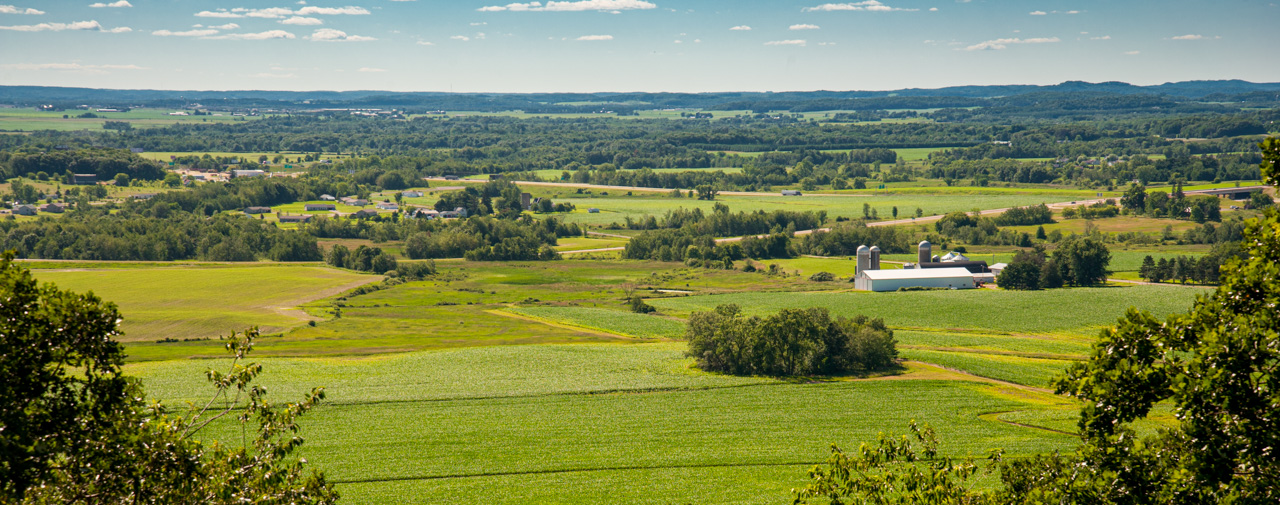
And what was there before the farms was forest. The county was “generally a timbered country,” with here and there an oak opening and a bit of prairie. West of the Red Cedar lay what people called the Big Woods — hard and soft maple, red and white and black oak, elm, ash, walnut and butternut, with a sprinkling of pine along the streams.16 Even by 1890, after two decades of clearing, only about a quarter of the county was under cultivation.
Which brings me to the question I couldn’t answer for a long time: why on earth would a German farming family choose this? Why walk past the open prairie of Illinois and Iowa, already broken and ready to plough, in order to go north into a wall of hardwood?
Part of the answer is that the Goetzes were already there and family pulls hardest. But part of it is the ground itself. The soil under those Big Woods was, in the words of the county’s own history, “naturally of the richest kind, and readily worked, abounding as it does in decayed vegetation, the accumulation of centuries,” laid over a stratum of limestone — and the different localities had “proved a great attraction to agriculturists.”
German farmers knew that. Where an American speculator saw an obstacle, a man from a Hessian village saw the thing he’d been taught to read since childhood: heavy hardwood means deep soil. Prairie sod was quicker but it was a gamble on ground nobody’s grandfather had ever farmed. Timber was slower and it was certain. And a man out of the Knüll — wooded ridges, hardwood and pine, a valley with a creek in it — was looking at a landscape he already understood, except that here there was more of it and nobody owned it yet.
The railway arrived in 1870, and that changed everything. The construction of the line is what brought Elk Mound its first settlers at all. Even so, the growth was slow: the village had seventy-five residents in 1880, and only about a hundred by 1890.17 The township as a whole counted 695 people in 1890.
That’s the scale of the place Michael Webert served eight years as a supervisor of. Seventy-five people in the village. A station, two churches, a post office, a district school, one store, one blacksmith and a steam feed mill.
VIII. ELIZABETH
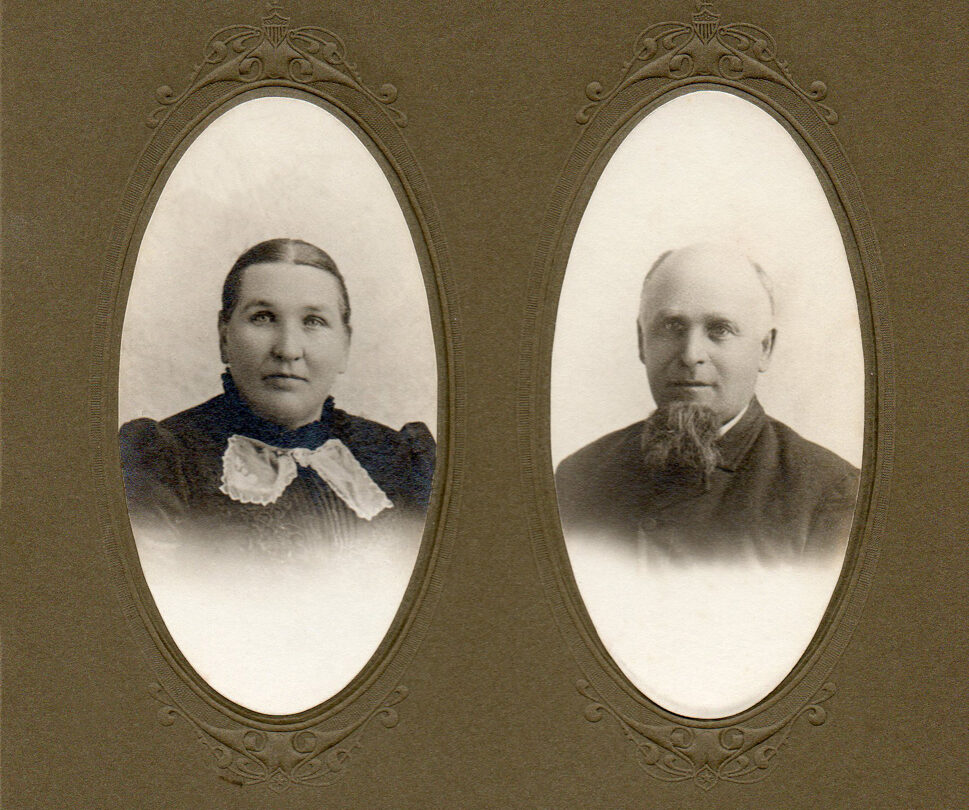
On 17 September 1869, at Spring Brook in Dunn County, Michael married Elizabeth Ausman.18
She’d been born on 13 August 1848 at Röhrda, up on the Ringgau plateau in the far east of Hesse, about nine kilometres south of Eschwege. Her parents weren’t young when she arrived — her father Heinrich was forty-seven and her mother Anna was forty.
Röhrda sat in the same country Michael came from, fifty kilometres from Olberode.19 Close enough to be countrymen. Far enough apart that they almost certainly never met until Wisconsin.
A small note for anyone who goes looking. The Wisconsin marriage index has them as Michael Herbert and Elizabetha Alzmann. That’s not an error to get annoyed about; it’s the sound of a German couple being written down by an English-speaking clerk doing his honest best with what he heard. Webert becomes Herbert. Ausman becomes Alzmann. If you go hunting for your German ancestors under the spelling on their gravestone, you won’t find half of them.
Her brother Henry came too, and Henry Ausman turned out to be the making of Elk Mound. He was farming when he started, but in 1878 he bought a small grocery in the village off a man who was also running a bar and selling beer and whiskey — and the first thing Henry did was cut out the bar and put in a stock of general merchandise instead. He ran that business for thirty-two years, was postmaster from 1878 until 1915, served as railway and express agent and notary public, sat in the Wisconsin State Assembly for Dunn County in 1879, and when the village finally incorporated in 1909 he was its first president.20
So Michael didn’t just marry a girl from home. He married into the family that would end up running the town.
He was twenty-five. She was twenty-one. Neither of them ever went back.
IX. MAKING A FARM
At the start they had almost nothing. In 1870 Michael was a man who works on farm, with five hundred dollars of real estate to his name, living a couple of doors down from his father, who had five times that.
Then he did the thing that took up the rest of his working life.
The Homestead Act. The law of 1862 let any person who was head of a family, or twenty-one years old, and either a citizen or someone who’d formally declared his intention to become one, claim up to a quarter section of surveyed public land. Michael took half of that — eighty acres. He didn’t get it for nothing. He got it for five years of his life: file the application, pay the fees, build a dwelling, live on it and work it for five continuous years, then go back to the land office, post notice in a newspaper, and turn up with two credible witnesses who’d swear on oath that he really had lived there and really had farmed it. Total cost in fees: eighteen dollars.21
Across the country, about four million homestead claims were filed and only around forty per cent were ever proved up. Six in ten failed — beaten by drought, isolation, winter, or the plain impossibility of making a farm out of raw land with no money.
Michael was in the forty per cent.
Naturalisation. On a Saturday in September 1876 the Dunn County News ran a short item on page four listing the men who’d taken out their full naturalisation papers at the recent term of the circuit court. Twenty-odd names, and among them, Michael Webert.
He didn’t need citizenship to vote. Wisconsin had deliberately enfranchised declarant aliens — foreign-born men who’d merely declared an intention to become citizens — after one year’s residence, in local, state and federal elections alike. It was designed to pull settlers in, and the state kept it until 1908.22 Michael could already vote, and probably had been.
So why bother in September 1876? Look at what happened seven months later.
The patent. On 25 April 1877, in the City of Washington, a document went out over the name of Rutherford B. Hayes, President of the United States, granting to Michael Webert and his heirs and assigns forever the south half of the south-west quarter of Section Twenty-four, Township Twenty-eight North, Range Eleven West. Eighty acres.23
Final proof needed the claimant’s citizenship in order. Taking his papers in the September and getting his patent the following April isn’t a coincidence. That’s a man tidying up the last requirement before he walks into the Eau Claire land office with two neighbours to swear the farm is his.
What eighty acres cost. The Act said “cultivate,” and that word hides what the job actually was.
The land didn’t arrive as a field. It arrived as forest — oak, maple and pine. You felled the trees with an axe and a crosscut saw, by hand, in winter. You hauled out what was usable and burned the rest, and the smoke of land-clearing fires hung over the whole valley every autumn. Then you were left with the stumps, and the stumps were the real enemy: grubbed out with a mattock and a spade, roots chopped through one at a time, levered and dragged clear with a chain and a team, a handful in a good day. Pine stumps were worse, because the resin kept them from rotting, so farmers often left them standing and ploughed around them for years. Then the rocks, which the frost pushed up fresh every spring, forever.
Clearing an acre properly was reckoned at weeks of work. Michael had eighty of them, plus a house to build, a wife and a growing family to feed while he did it.
Where the money came from in those first years I can’t say for certain. Elk Mound itself saw very little logging — the big timber money was over on the Red Cedar, where Knapp, Stout & Co. of Menomonie was by then the largest lumber company in the world. Settlers across the region routinely worked the winter camps to raise enough to start a farm, sometimes taking their wages in boards to build the barn, and it would be the obvious thing for a young man with eighty acres of stumps and no cash to do between November and March.24 But that’s an inference about a common practice, not a fact about Michael.
For a man out of Olberode, it’s hard to overstate what that patent meant. He was born where land was a closed question and the answer was always no. Twelve years after arriving with nothing, he owned land outright. Not rented, not shared, not held at a landlord’s pleasure. Owned, and passable to his children.
X. THE FIELD OVER THE FENCE
In the spring of 1882, Michael bought a farm from his cousin.
Adam Pfaff sold him the west half of the north-west quarter of Section 25, along with a piece of Section 10, for two thousand two hundred dollars.25
The two of them were first cousins. Adam’s mother Anna Katharina and Michael’s mother Anna Catharine were both daughters of Johann Adam Goetz — sisters born four years apart in the same Hessian village.26 They’d also been next-door neighbours in Elk Mound since at least 1875.
And look where the land was. In the surveyors’ grid, Section 25 sits directly beneath Section 24. The parcel he bought ran along the northern edge of Section 25 at its western end — straight across the line from the ground he’d cleared by hand five years earlier.
He bought the field over the fence.
Eighty acres granted by the government, eighty bought from his cousin, side by side. A hundred and sixty acres in one block — which is precisely the full quarter section the Homestead Act would have handed him for nothing if he’d claimed the maximum in the first place. He got there anyway. He just paid for the second half.
The price tells its own story. The homestead cost him eighteen dollars in fees and five years of labour. This cost two thousand two hundred dollars, for improved land already cleared and broken. Twelve years earlier, everything Michael Webert owned in the world had been reckoned at five hundred.
His land didn’t grow outward into a strange country. It grew along a line of his mother’s relatives — and so did his family. Michael married an Ausman; three of his sisters married Ausmans too. Four children of George and Anna Webert married into one local family, the same family that ran the store and the feed mill in the village. The Weberts had no cousins of their own to marry out of, so they married into their neighbours until the two were the same thing.
XI. SUPERVISOR WEBERT
In April 1880 the men of Elk Mound met to elect their town officers, and Michael Webert was chosen one of the three supervisors of the town.27
Sit with that a moment. He’d landed in America with nothing and no English. He’d taken his citizenship papers less than four years before. And the farmers of Elk Mound — Norwegians, Germans and Yankees who had every option to pick somebody else — put him on the board that ran the place.
A Wisconsin town board was three men, elected each spring, and its business was the unglamorous machinery of local life: the roads, the bridges, the town’s money, poor relief, and reviewing what everybody’s property was worth for tax. It wasn’t a grand office. It was the office that decided whether the road past your farm got graded before the spring thaw turned it to soup.
Roads were the main business, year after year. In 1880 the town meeting voted three hundred dollars to the road fund; two years later, four hundred for a special road fund. That’s what the government of Elk Mound largely amounted to — a handful of neighbours working out how much they could stand to tax themselves to keep the mud passable.
And he kept the job. Supervisor again in 1882, in 1884, in 1887 — at least eight years on the board under three different chairmen, and he served the school district as clerk and as director as well. The names beside his tell you what kind of place it was: Gunder Robbe, Gabriel Jenson, Arne Tilleson, Ole Tilleson, Christ Ludvigson, Carl Bergren, a wave of Norwegians; J. J. Myrick and Richard Roberts and L. S. Frink from the older American stock; and alongside Michael the German names of Nicholas Ausman, Peter Schaaf and Anton Rosenberg.
Two of those are worth marking. J. F. Quilling chaired the board in 1880. Nicholas Ausman sat as justice of the peace. Michael’s wife was an Ausman. His son William would one day marry a Quilling. In a township of a few hundred souls, the men who governed, the men who married your daughters and the men who lent you a wagon were all the same men.
XII. THE HOUSE FILLING UP
Michael and Elizabeth had eleven children between 1871 and 1892.
A baby, born and died in 1871. Henry George, May 1872. A second baby, born and died about 1874. Then William (1875), John (1878), Samuel Frederick (1879), Arthur Benjamin (1882), George Alvin (1884), Alfred (1886), Leora Elizabeth (1888), and finally Ella, born February 1892.
Elizabeth was twenty-two when the first came and forty-three when the last did. For most of two decades she was pregnant, or nursing, or both — while feeding a hired man, keeping her widowed mother in the house, and running a home with no plumbing, no electricity and no help but her own daughters, who didn’t arrive until she was forty.
The two who didn’t live are down in the records only as “Baby Webert,” and both lie in the churchyard at Elk Mound. They have no names because they died before there was time to give them one, or because whatever name they were given was never written anywhere that survived. Everybody else in this story has a headstone with a life on it. Those two have a date, twice.
Look at the names of the ones who lived, too. Henry George — for his grandfather. Then William, John, Samuel, Arthur, George Alvin, Alfred, Leora, Ella. Not a Wilhelm or a Johann or a Georg among them. They spoke German at home and worshipped in a German church, and they gave their children American names from the very first. That was a decision, and they made it eleven times.
Wisconsin counted its people between the federal censuses, and in Elk Mound the counting was done by the town clerk — for twenty years, T. E. Tilleson, who sat on the town board beside Michael. His tallies show the house filling up.28
In June 1875 it held four: Michael, Elizabeth, three-year-old Henry, and one more woman, almost certainly Elizabeth’s widowed mother.
By June 1885 it held ten — eight males and two females — and four of the ten were German-born. Since only Michael and Elizabeth were born in Germany, the two extra people in that house, a man and a woman, were German-born too. He was running a farm with a household of ten and hiring German help to do it, because his own sons were still children.
By June 1895 the count was eleven, and it matches the family exactly, person for person: Michael and Elizabeth born in Germany, and nine children all born in Wisconsin. No hired man. Nobody else in the house at all.
Hold on to that, because it explains what happened six months later.
XIII. WHAT THE NEIGHBOURS SAW
The Dunn County News carried a column of Elk Mound doings written by a local correspondent who signed himself sometimes ELL JAY and sometimes HEART OF OAK. Everyone in the village knew perfectly well who was writing it, and the writer knew that everyone knew. The pen-name was a courtesy, not a disguise.
April 1879. A farmer from a few miles north-east came into the station on a Sunday saying he wanted alcohol as medicine for a sick cow. He got it, and a good deal more besides, and by that afternoon he was in the ditch by the railroad crossing east of the village, past helping himself. Michael Webert, driving home from church, stopped, had the man lifted into his wagon, and took him home.29
The correspondent’s real subject was the disgrace of a place that would sell drink on the Sabbath, and that argument had a local edge to it. Michael’s brother-in-law Henry Ausman had bought the village grocery the year before and immediately thrown out its bar. The family were on the dry side of a fight rural Wisconsin conducted at volume for the next forty years.
But under the sermon there’s a clear small picture of Michael at thirty-five: at church on a Sunday morning, and not a man who’d drive past somebody lying in a ditch.
February 1883. A legal notice, headed TAKEN UP. The subscriber, living on Section 24, township 28, range 11, has taken up one red steer with white spots, about a year old, and one red heifer likewise. The owner is asked to call, prove property, pay charges and take them away. Signed M. WEBERT.30
Fencing was patchy and stock wandered, and a man who found somebody else’s animals had a duty to advertise them and a right to be paid for their keep. But that notice does something better for us: it has Michael telling the county, in his own words, exactly where he lived — the same description as his patent, six years on.
November 1885. Tucked between a note about a traveller whose own family failed to recognise him and a very Victorian obituary for a five-year-old girl, the correspondent reports that Mr M. Webert has a pig which exhibits strange freaks of nature: the animal had been found on top of the corn crib, ten feet off the ground, and how it got there was a mystery to everybody.31
That’s the whole item. It isn’t important. It’s also the only surviving trace of what Michael Webert’s neighbours found funny, and the only moment in the entire record where you can hear anybody laughing.
XIV. TAKES THE CAKE
His mother didn’t live to see his best year.
Anna Catharine Webert, née Goetz, died on 31 January 1894 at Elk Mound, in the house of her son-in-law H. Buschendorf, aged sixty-nine years, five months and thirteen days. Her pastor wrote her farewell in German, for a German paper.
She’d been thoroughly converted, he wrote, and had joined the Evangelical Association; she lived piously and died blessed, and the congregation had lost one of its oldest and most faithful members. She left a husband of nearly fifty years, seven children, three surviving brothers and sisters — and forty-four grandchildren.32
Twenty-two months after they buried her, on Friday 13 December 1895, the Elk Mound column opened with a boast on her eldest son’s behalf:
M. Webert takes the cake in this vicinity in raising small grain by getting 10,000 bushels.33
It’s a throwaway line, and it’s the single most informative sentence anybody ever wrote about him.
“Small grain” is a precise term, not a loose one. It means the close-sown cereals — wheat, oats, barley, rye — as against corn, which is planted in rows and cultivated. So this wasn’t a corn crop. And it almost certainly wasn’t wheat: wheat had collapsed across Wisconsin over exactly the decades Michael had been farming, killed by exhausted soil, western competition and the chinch bug, and by the nineties the state was well into its turn toward dairying. Wheat then yielded about thirteen bushels to the acre. Ten thousand bushels of it would have meant close to eight hundred acres.
Oats fit, and the county’s own figures make it plain. In 1890 the whole of Dunn County produced 999,538 bushels of oats — against 130,774 of wheat and a mere 10,296 of barley. Oats outran wheat nearly eight to one. By then Dunn was the leading dairy county in the Chippewa Valley, making nearly twice as much butter as Eau Claire and Chippewa put together, and oats were what fed the horses and the cows.34
So Michael’s ten thousand bushels was roughly one per cent of everything the county harvested, off one farm among a couple of thousand. By weight it’s about a hundred and sixty tons. The village elevator by the tracks — there’d been one at Elk Mound since 1874 — held twenty thousand bushels when full.35 He could have filled half of it himself.36
Now put that against what he actually held. By 1888 he had his name on three parcels in the Town of Elk Mound — two of eighty acres and one of forty. Two hundred acres in all.37 There’s the shape of his working life drawn on a map: the eighty the government granted him in 1877, the eighty he bought from his cousin in 1882, and a forty added somewhere along the way.
Two hundred acres wouldn’t all have been in grain. A farm that size carried hay and pasture, a woodlot, a garden, buildings and yards. Which means the boast wasn’t really about acreage at all. It was about yield. To get ten thousand bushels off that ground he needed something in the region of forty to fifty bushels an acre — well above the average of the day, in a district where every one of his neighbours farmed the same soil under the same sky.
That’s why it was worth printing. M. Webert took the cake not because he had the most land — plenty of men in the township held two hundred acres — but because he got more off it than anybody else.
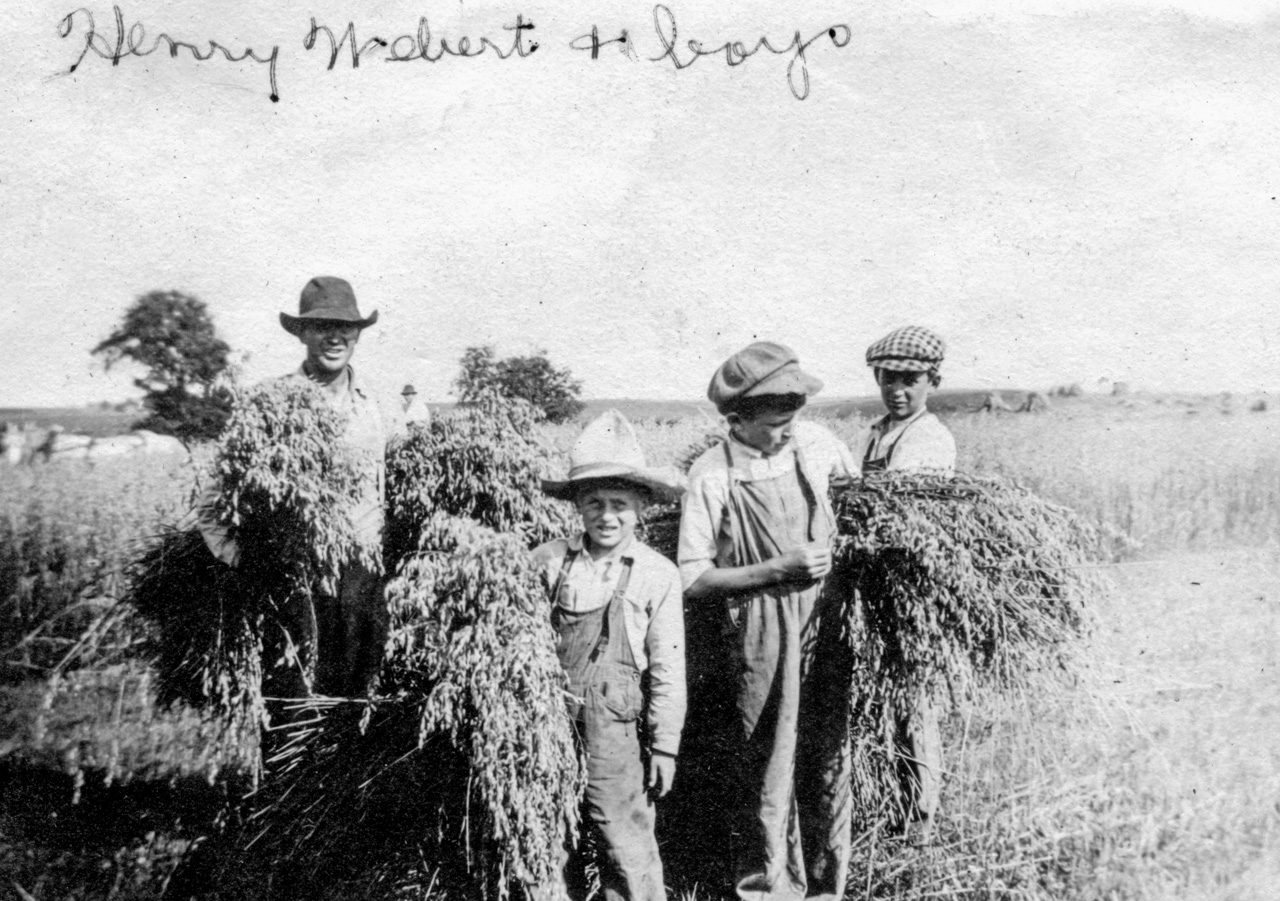
And we know how. That June the house held Michael, Elizabeth and all nine living children, and nobody else. Henry was twenty-three, William nineteen, John seventeen, Samuel fifteen, Arthur thirteen, George ten. Ten years earlier Michael had needed hired hands because his sons were too small to swing a scythe. Now he had six of them, and he’d let the hired help go.
Eleven children is a great many mouths to feed. It’s also, by the middle nineties, a threshing crew. The first eighty acres were cleared by one man with an axe. The two hundred were worked by his children.
XV. THE WIND
On Tuesday 24 March 1896 a tremendous wind blew across Wisconsin, Minnesota and the Dakotas — almost a gale, filling the air with dust and making it hardly bearable to be outside. Wind like that catches sparks. Across three states that day, fires started and couldn’t be stopped.
Dunn County took its share. And in Elk Mound, Michael Webert lost his house and everything in it. The loss came to twelve hundred dollars. He was insured for eight hundred and fifty.38
There was nothing to call. Elk Mound wouldn’t organise even a volunteer fire company, with a hand-pumping engine and a water tank on wheels, until around 1905.39 In March 1896 a burning farmhouse burned until it stopped.
Sit for a moment with where that falls. Three months earlier the county paper had been telling everybody he took the cake. He was fifty-two, at the top of his working life, the most successful grain farmer in the district. And on a windy Tuesday in March he stood in his own yard and watched the house go — the furniture, the bedding, the clothes, the tools, whatever photographs there were, whatever had come across the Atlantic in a chest, whatever Elizabeth had carried out of Röhrda as a girl. All of it.
Nine children had been born in that house. Two of them had died in it.
Seventeen days later the Elk Mound column reported that Michael Webert was hauling material for a new dwelling house, to be put up in place of the one recently destroyed by fire.40
Seventeen days. He’d barely finished counting the loss and he was already out on the road with a wagon, fetching lumber.
By 11 September the job was done. Mike Webert and family, the correspondent wrote, had now moved into their new residence, which was the largest and most substantial house in town.41
The house burned in March. By early September they were living in a new one, and it was the biggest in the township.
Town, in Wisconsin, means the township — the six-mile square, not the village. This new house stood on the farm. So what the correspondent meant was that of every farmhouse standing in the Town of Elk Mound that autumn, Michael Webert’s was the largest and best built.
And here’s the thing to notice, because by now he’s done it four times.
His family sailed without him; he followed alone. The government gave him eighty acres; he bought eighty more. His house burned to the ground; he had lumber on the road inside a fortnight and the finest house in the township up by harvest.
He didn’t absorb blows. He answered them, and he answered them larger.
XVI. WHAT DIDN’T HOLD
Almost nothing he built stayed built.
John. On 10 August 1900, John Webert died at Elk Mound. He was twenty-two. He’d had rheumatic fever, and his heart failed.
That sequence needs explaining, because it was then among the commonest ways for a young person to die. Rheumatic fever follows an ordinary streptococcal throat infection — what we now call strep throat and clear up with a week of penicillin. In some people the body’s response to the infection turns on the body itself, and among the tissues it attacks are the valves of the heart. The joints ache and then recover. The heart doesn’t. Scarred valves make it work harder to move the same blood, and it goes on working harder for months or years until it can’t keep up. Then a young man who’s been short of breath on the stairs, who tires when his brothers don’t, dies of heart failure at twenty-two.
There was no penicillin. Alexander Fleming was a schoolboy in Scotland. Knowing about the link wouldn’t have changed a thing, because there was nothing to do about it. Treatment amounted to bed rest and aspirin.
So John was ill a long time, and everyone watched it happen. He was a grown son on a working farm; whatever he could no longer do, his brothers did instead, and every person in that house knew what it meant. Michael and Elizabeth had buried two babies in the seventies. Now they buried a son they’d raised to manhood.
The farm. On 22 January 1902 the correspondent reported that Mike Webert, a prominent farmer of this vicinity, had sold his farm and intended to move into the village.42
Think about what was being sold. Eighty acres granted by the United States and cleared by hand out of standing timber. Eighty more bought from his cousin. Whatever else he’d added across two decades. And the largest and most substantial house in the township, put up in a single summer after the fire.
Twenty-five years of one man’s work, in a single transaction.
It went out of the family. Henry was farming, but he had his own place at Rusk by then, and a wife and children. William was in Elk Mound. Samuel was in Chicago studying dentistry — which is its own quiet marker of how far one generation had travelled from a Hessian village. Arthur, George and Alfred were still young men. None of them took it on.
That happens in farm families more often than the stories admit. A father assembles a holding over a working lifetime, and at the end there’s no son who wants that particular ground on those particular terms at that particular moment. The land doesn’t pass down. It gets sold, the money divided, and something that took twenty-five years to put together comes apart in an afternoon at a lawyer’s desk.
Reading forward, though, the likeliest reason is the simplest. He was fifty-eight, and he was starting to be ill.
XVII. AGAIN
Because Elk Mound had a correspondent who filed every fortnight, we can watch Michael Webert’s last illness almost week by week, in print, the way his neighbours watched it.
In the spring of 1903 the voters elected him town assessor. He never took the office; he was too ill to serve. There’s something painful in that. The last thing his neighbours did for him was elect him to a job he couldn’t do.
In July 1903 his father died — George August Webert, eighty-three years old, at Spring Brook, of a bladder injury and the infection that followed it.43 Michael buried him while already sick himself.
On 14 October 1903, between a note that sneak thieves were about and one that Miss Laura Ausman was visiting her sister at Bloomer: Mike Webert is very low.44
On 16 December 1903, among the wedding cards and the students home for Christmas: Mike Webert is again very low.45
That word does a lot of work. It means he’d rallied. It means the village had been told he was dying, and then he wasn’t dying, and now he was again.
Then, on 1 March 1904: Mr Mike Webert, who has been confined to his home for some months, was a caller at the home of his son, Will, on Tuesday.46
Read that twice. A man who hasn’t been out of his house since the previous autumn gets himself up, gets dressed, and goes to see his son. It’s the last time Michael Webert is recorded doing anything at all. Whatever it cost him, he wanted to sit in Will’s house one more time, and somebody thought it worth telling the county paper.
Three weeks later, on 23 March: Mike Webert is again quite sick.
He died five weeks after that.
XVIII. 26 APRIL 1904
He died at his home in Elk Mound on the morning of Tuesday 26 April 1904, aged sixty years, five months and eighteen days.
What killed him was acute Bright’s disease, on top of a bad cold, after six weeks.47
Bright’s disease is the old name for kidney disease — what we’d now call nephritis, and most often glomerulonephritis, inflammation of the filtering units of the kidney. It’s named for Richard Bright of Guy’s Hospital, who in 1827 gathered twenty-five cases of dropsy, tied them to diseased kidneys, and made a category out of what until then had just been called swelling. Bright himself listed scarlet fever among its causes.
That last point is worth pausing on. The commonest form of acute nephritis in Michael’s day followed a streptococcal infection by a week or two — which is exactly what that “severe cold” is describing. And four years earlier his son John had died of rheumatic fever, which is also an immune reaction to a streptococcal infection, arriving instead at the heart. We can’t diagnose the dead. But it’s at least striking that father and son, in the same house four years apart, were most likely killed not by an infection itself but by what their own bodies did in answer to one.
The six weeks needs reading carefully too. Michael had been very low in October, very low again in December, and shut in the house all winter. Six weeks runs back only to the middle of March. It describes the final illness, not the long decline behind it.
Two small human details sit in the paperwork of his death. Asked whether he’d ever been a United States soldier or sailor, somebody wrote No — which is true, and says nothing at all about the young man who stayed behind in Hesse in 1865. And the lines for his father’s and mother’s names were left blank. By then there was nobody left to ask.
The funeral was on the Sunday morning, 1 May, at ten o’clock, from the German church — the old rural Evangelical congregation about a mile south and a mile east of the village, which held its services in German right up until 1907.48 He was buried in Evergreen Cemetery, where his mother already lay, and John, and the two babies with no names, and where — a hundred and ten years later — I stood with my son and a dozen cousins on a bright July morning without yet knowing much of anything about him.49
They counted up his life in the county paper that week. Born in Germany, 8 November 1843. Came to Dunn County, settled on a farm in the Town of Elk Mound, lived there until two years before his death. Married Elizabeth Ausman at Spring Brook in 1869. A wife and eight children survived him, and one brother and six sisters. He was a prosperous farmer in his town where he had lived for so many years. He was clerk and director of the school board.
And the village correspondent, writing his own paragraph in the same issue, put it more plainly. Michael Webert had been sick for some time and his death was not unexpected. He was a good neighbour, and a kind husband and father.50
XIX. WHAT HE LEFT
Here’s something I didn’t expect to find.
Michael Webert had eleven children. When he died on 26 April 1904, he had exactly three grandchildren.
All three were Henry’s, born out at Red Cedar: Raymond Henry, who was four; John Charles, who was three; and Alvina, who was eleven months old. Nobody else had given him one. Henry had married in 1898, but William didn’t marry until 1903 and had no children yet, and Samuel, Arthur, George, Alfred, Leora and Ella were all still to come — the last of them wouldn’t marry until 1915. Michael died at sixty, and sixty was too early. His family was just about to happen and he missed it.
Set that against his own father. When Anna died in 1894, she and George had forty-four grandchildren. Michael, ten years later, had three.
Elizabeth did better. By the time she died on 21 August 1920 there were seventeen, and the last of them — James Douglas Baird — had been born seven days earlier. She got to hear about him.
And the eldest of that three, Raymond Henry Webert, four years old when they buried his grandfather at Elk Mound, was my grandfather.
Now count forward.
The tree as it stands records one hundred and seventy-seven descendants of Michael Webert and Elizabeth Ausman, across seven generations. That’s certainly an undercount — living people go unrecorded, whole branches thin out into names nobody has chased. But it’ll do for a number.
They are not in Elk Mound any more. They’re in Wisconsin and Minnesota, in California and Washington and Oregon, in Iowa and Indiana and Illinois, in Texas and Arizona and Colorado, in New York and Virginia and Ohio and Florida and Nebraska and the Dakotas. One of them, George W. Baird — Michael’s great-grandson, born in Elk Mound in 1918 — was killed over Hungary in November 1944, forty years after his great-grandfather died and eighty years after that great-grandfather had put on the Elector’s uniform in Hesse.
And two of them are in Australia. My son Joseph was born in Adelaide in 1997. I live on the coast in Western Australia, about as far from a Hessian village as it is possible to get and still be on the planet.
Eleven children. Three grandchildren at his graveside. A hundred and seventy-seven so far.
That’s what happens when a twenty-one-year-old lets his family sail without him and then goes after them.51
XX. THE FIELD
Elizabeth lived another sixteen years. She died on 21 August 1920 at Rusk, in the Town of Red Cedar, eight days after her seventy-second birthday, and was buried beside him.
She’d crossed an ocean as a girl, married at twenty-one, borne eleven children in twenty-one years and buried three of them, kept her widowed mother in her house, watched everything she owned burn on a Tuesday in March, and outlived her husband by sixteen years. She left almost no words behind. Almost none of them ever did.
Their sons and daughters went out from Dunn County the way that generation did — to Rusk and Menomonie and Stanley, to Minnesota, Iowa, Indiana, South Dakota. Henry George, the eldest surviving and my great-grandfather, farmed near New Richmond and lived until 1961, dying at eighty-eight.
Michael Webert crossed an ocean alone. He cut a farm out of a forest. He bought the field over the fence from his cousin. He buried three of his children. He sat eight years on the board that governed his township and served its school. He lost his house to fire and had lumber on the road within a fortnight. He grew more grain to the acre than any man in his district. And he died a citizen and a landowner, sixty years after being born a subject of the Elector of Hesse in a village of a few hundred souls.
Almost none of it lasted. The farm was sold and left the family. The house is gone. His own crossing was never recorded, because Bremen burned the lists. Even his name won’t stay still across the documents — Weber, Webert, Herbert, Micheal — and on the record of his death the lines for his parents were left empty.
But there’s a piece of ground a few miles out of Elk Mound where the corn still comes up every summer, and on a July afternoon in 2014 my son stood in it because he’d never stood in a cornfield before.
It isn’t a natural feature. A young man from a village in the Knüll hills made it, by hand, out of oak and maple and pine, and it cost him years of his life.
It’s still there. Of everything Michael Webert built, that’s the thing that lasted — and my boy was standing in the middle of it, a hundred and forty years later, on the other side of the world from where his great-great-great-grandfather was born.
Now at least he knows whose field it is.
NOTES
1. Historisches Ortslexikon für Hessen, LAGIS, entry “Olberode, Schwalm-Eder-Kreis.” Olberode stayed a filial of the parish of Oberaula until 1900, so Webert baptisms, marriages and burials of this period belong in the Oberaula church book — a point confirmed independently by Anna Webert’s 1894 obituary, which gives her birthplace as “Olberoda, Amt Oberaula, Kreis Ziegenheim, Kurhessen.”
2. LAGIS, entries “Schorbach” and “Weißenborn,” occupational surveys of 1776 and 1777.
3. Chronik zur 650-Jahrfeier Olberode (2014), emigrant list, which records George Webert, born 25 August 1819, Ackermann, and Anna Catharina née Goetz, born 18 August 1824. Michael’s birth date is confirmed by his headstone; the marriage date the chronicle gives for his parents needs a second source before it can be relied on. The same list assumes Michael emigrated with the family in 1865; he does not appear on the ship’s passenger list, and the compilers seem simply to have counted him with his parents.
4. Rolf Gehrmann, “Infant Mortality in Germany in the 19th Century,” Comparative Population Studies 36, no. 4 (2011): 839–868. Regierungsbezirk Kassel, about 20.7 per cent for 1833/37, falling to 16.4 per cent by 1875/80.
5. Ulrich Pfister et al., “Food Crises in Germany, 1500–1871”; Rüdiger Glaser et al., “Climate of migration?”
6. Chronik zur 650-Jahrfeier Olberode (2014), “Die Auswanderer aus Olberode – Reise in eine ungewisse Zukunft,” and its list of emigrants to America, 1852–1883. The same section records the 1837 departures for Poland.
7. Same source, which dates the departure of Adam Götz (Landbauer) and Joh. Heinrich Götz, born 10 September 1833, to 1853. Family trees have sometimes given 1848; the village chronicle should be preferred. The Diebel family, including Anna Maria née Goetz, is listed as leaving in 1861.
8. Thomas Brenner et al., “Inheritance Institutions and Landholding Inequality in Nineteenth-Century Germany,” Journal of Economic History 81, no. 3 (2021): 909–942.
9. Hessen-kasselsche Armee, drawing on Fuchs, Zeitschrift des Vereins für hessische Geschichte 106 (2001).
10. Deutsche Auswanderer-Datenbank, “The emigration port”; FamilySearch, “Bremen Emigration and Immigration.” The Main-Weser line reached Treysa on 2 January 1850; the Hannöversche Südbahn reached Göttingen in September 1856; the Bremen–Bremerhaven line was finished in 1862.
11. Nine Weberts appear on the manifest of the America, arriving New York 9 November 1865 — George (as August), Anna and seven children. Michael is not among them. Anna’s 1894 obituary says eight children and gives the first settlement as the Town of Sigel with a move to Elk Mound two years later; the family’s own account has Cadott and one year.
12. Hessisches Landesarchiv, “Auswanderer.”
13. Hessen-kasselsche Armee, as above.
14. Contemporary descriptions of the Castle Garden Emigrant Landing Depot, opened August 1855.
15. Population of Dunn County by census year, from the History of the Chippewa Valley (1892): 1855, 1,796; 1860, 2,704; 1865, 5,170; 1870, 9,488; 1875, 13,427; 1880, 16,818; 1885, 21,951; 1890, 22,664.
16. Same source, on the county’s timber, the “Big Woods,” the soil over limestone, and the proportion of land under cultivation.
17. History of Dunn County (1925), on the platting of Elk Mound village, the railway of 1870 bringing the first settlers, and village population of 75 in 1880.
18. Wisconsin Marriages, 1836–1930, indexed as Michael Herbert and Elizabetha Alzmann; the 1904 obituary locates the wedding at Spring Brook.
19. LAGIS, entry “Röhrda”: Kurfürstentum Hessen, Provinz Niederhessen, Kreis Eschwege from 1821. Röhrda is today an Ortsteil of Ringgau, Werra-Meißner-Kreis.
20. Same source, on Henry Ausman’s grocery, his removal of the bar, his 32 years in business, his term as postmaster and his village presidency. His 1879 term in the State Assembly is from the History of the Chippewa Valley (1892). Henry was Elizabeth’s brother.
21. National Park Service, “The Homestead Act”; National Archives, Homestead Act (1862).
22. Wisconsin Constitution of 1848, Article III; the declarant-alien franchise was repealed in 1908.
23. United States land patent, Homestead Certificate No. 1785, Application No. 1477, Eau Claire land district, 25 April 1877.
24. Wisconsin Historical Society and Dunn County Historical Society on Knapp, Stout & Co.
25. Dunn County News, 3 June 1882, weekly list of real-estate transfers. The abbreviations follow the paper’s shorthand and should be confirmed against the Dunn County deed books.
26. Adam Pfaff (1849–1914), son of Anna Katharina Paff (1820–1889); the cousinship rests on both mothers being daughters of Johann Adam Goetz, which should be confirmed in the Oberaula parish register. The surname appears as both Paff and Pfaff.
27. Dunn County News, 10 April 1880, 8 April 1882, 5 April 1884 and 9 April 1887.
28. Wisconsin state censuses, Town of Elk Mound: 1 June 1875, 22 June 1885 and 20 June 1895, each taken by T. E. Tilleson, town clerk. They give heads of families with counts by sex, and from 1885 by nativity. In 1875 Adam Pfaff is the household immediately adjoining Michael’s. The 1890 federal census was destroyed by fire in 1921; these state returns largely fill the gap.
29. Dunn County News, 12 April 1879, p. 5, signed ELL JAY.
30. Dunn County News, 3 February 1883, p. 4, estray notice dated 11 January 1883.
31. Dunn County News, 28 November 1885, p. 5, signed HEART OF OAK.
32. German-language obituary of “Mutter Catharina Webert, eine geb. Götz,” signed S. Friedrich. Her age of sixty-nine years, five months and thirteen days works back to a birth date of 18 August 1824, matching the Olberode chronicle exactly.
33. Dunn County News, 13 December 1895, p. 5.
34. Dunn County farm products for 1890, History of the Chippewa Valley (1892), which also ranks Dunn first for butter and cheese in the valley.
35. History of Dunn County (1925), on the Elk Mound elevator from 1874 and the capacity of its successor.
36. Decade averages for 1890–99: wheat about 13.1 bushels an acre, oats about 26.2. Bushel weights: oats 32 lb, barley 48 lb, wheat 60 lb. The implied yield is an estimate, not a record.
37. Plat of Elk Mound, Township 28 North, Range 11 West, in the 1888 Dunn County plat book.
38. Dunn County News, 27 March 1896, p. 5, “Disastrous Fires.”
39. Same source, on the organisation of the volunteer fire department about 1905.
40. Dunn County News, 10 April 1896, p. 5.
41. Dunn County News, 11 September 1896, p. 4.
42. Dunn County News, 24 January 1902, p. 8, dated 22 January.
43. Wisconsin death certificate of George Webert, died 11 July 1903 at Spring Brook, aged 83 years 10 months 16 days; primary cause injury of bladder, secondary cystitis, duration six weeks.
44. Dunn County News, 16 October 1903, p. 8.
45. Dunn County News, 18 December 1903, p. 8.
46. Dunn County News, 4 March 1904, p. 8. The item doesn’t name the place; the 1904 obituary puts William at Elk Mound.
47. Wisconsin Register of Deaths, certificate no. 109, registered 9 May 1904. Attending physician R. R. Chase, M.D.; undertaker Frank Hintzman.
48. Same source, on Trinity Evangelical Church, whose congregation began at a rural location about a mile south and a mile east of the village and held services in German until 1907. The Evangelical Church in America was founded in Pennsylvania by Germans; the mother congregation of the district began as a Sunday school at Iron Creek in 1861.
49. The death record gives the burial place as “Evangelical Cemetery,” and the 1888 plat marks a German Evangelical church and cemetery in the township. The grave itself is in Evergreen Cemetery at Elk Mound, so the two names almost certainly describe the same ground before and after a change of name.
50. Dunn County News, 29 April 1904, obituary on p. 5 and the Elk Mound column on p. 8. The obituary says six sisters survived but names five.
51. Descendant counts from the family tree as it stands: three grandchildren living at Michael’s death on 26 April 1904, seventeen at Elizabeth’s on 21 August 1920, and 177 recorded descendants across seven generations. The last figure is a floor, not a total.
NOTES
1. Historisches Ortslexikon für Hessen, LAGIS, entry “Olberode, Schwalm-Eder-Kreis.” Olberode stayed a filial of the parish of Oberaula until 1900, so Webert baptisms, marriages and burials of this period belong in the Oberaula church book — a point confirmed independently by Anna Webert’s 1894 obituary, which gives her birthplace as “Olberoda, Amt Oberaula, Kreis Ziegenheim, Kurhessen.”
2. LAGIS, entries “Schorbach” and “Weißenborn,” occupational surveys of 1776 and 1777.
3. Chronik zur 650-Jahrfeier Olberode (2014), emigrant list, which records George Webert, born 25 August 1819, Ackermann, and Anna Catharina née Goetz, born 18 August 1824. Michael’s birth date is confirmed by his headstone; the marriage date the chronicle gives for his parents needs a second source before it can be relied on. The same list assumes Michael emigrated with the family in 1865; he does not appear on the ship’s passenger list, and the compilers seem simply to have counted him with his parents.
4. Rolf Gehrmann, “Infant Mortality in Germany in the 19th Century,” Comparative Population Studies 36, no. 4 (2011): 839–868. Regierungsbezirk Kassel, about 20.7 per cent for 1833/37, falling to 16.4 per cent by 1875/80.
5. Ulrich Pfister et al., “Food Crises in Germany, 1500–1871”; Rüdiger Glaser et al., “Climate of migration?”
6. Chronik zur 650-Jahrfeier Olberode (2014), “Die Auswanderer aus Olberode – Reise in eine ungewisse Zukunft,” and its list of emigrants to America, 1852–1883. The same section records the 1837 departures for Poland.
7. Same source, which dates the departure of Adam Götz (Landbauer) and Joh. Heinrich Götz, born 10 September 1833, to 1853. Family trees have sometimes given 1848; the village chronicle should be preferred. The Diebel family, including Anna Maria née Goetz, is listed as leaving in 1861.
8. Thomas Brenner et al., “Inheritance Institutions and Landholding Inequality in Nineteenth-Century Germany,” Journal of Economic History 81, no. 3 (2021): 909–942.
9. Hessen-kasselsche Armee, drawing on Fuchs, Zeitschrift des Vereins für hessische Geschichte 106 (2001).
10. Deutsche Auswanderer-Datenbank, “The emigration port”; FamilySearch, “Bremen Emigration and Immigration.” The Main-Weser line reached Treysa on 2 January 1850; the Hannöversche Südbahn reached Göttingen in September 1856; the Bremen–Bremerhaven line was finished in 1862.
11. Nine Weberts appear on the manifest of the America, arriving New York 9 November 1865 — George (as August), Anna and seven children. Michael is not among them. Anna’s 1894 obituary says eight children and gives the first settlement as the Town of Sigel with a move to Elk Mound two years later; the family’s own account has Cadott and one year.
12. Hessisches Landesarchiv, “Auswanderer.”
13. Hessen-kasselsche Armee, as above.
14. Contemporary descriptions of the Castle Garden Emigrant Landing Depot, opened August 1855.
15. Wisconsin Marriages, 1836–1930, indexed as Michael Herbert and Elizabetha Alzmann; the 1904 obituary locates the wedding at Spring Brook.
16. LAGIS, entry “Röhrda”: Kurfürstentum Hessen, Provinz Niederhessen, Kreis Eschwege from 1821. Röhrda is today an Ortsteil of Ringgau, Werra-Meißner-Kreis.
17. National Park Service, “The Homestead Act”; National Archives, Homestead Act (1862).
18. Wisconsin Constitution of 1848, Article III; the declarant-alien franchise was repealed in 1908.
19. United States land patent, Homestead Certificate No. 1785, Application No. 1477, Eau Claire land district, 25 April 1877.
20. Wisconsin Historical Society and Dunn County Historical Society on Knapp, Stout & Co.
21. Dunn County News, 3 June 1882, weekly list of real-estate transfers. The abbreviations follow the paper’s shorthand and should be confirmed against the Dunn County deed books.
22. Adam Pfaff (1849–1914), son of Anna Katharina Paff (1820–1889); the cousinship rests on both mothers being daughters of Johann Adam Goetz, which should be confirmed in the Oberaula parish register. The surname appears as both Paff and Pfaff.
23. Dunn County News, 10 April 1880, 8 April 1882, 5 April 1884 and 9 April 1887.
24. Wisconsin state censuses, Town of Elk Mound: 1 June 1875, 22 June 1885 and 20 June 1895, each taken by T. E. Tilleson, town clerk. They give heads of families with counts by sex, and from 1885 by nativity. In 1875 Adam Pfaff is the household immediately adjoining Michael’s. The 1890 federal census was destroyed by fire in 1921; these state returns largely fill the gap.
25. Dunn County News, 12 April 1879, p. 5, signed ELL JAY.
26. Dunn County News, 3 February 1883, p. 4, estray notice dated 11 January 1883.
27. Dunn County News, 28 November 1885, p. 5, signed HEART OF OAK.
28. German-language obituary of “Mutter Catharina Webert, eine geb. Götz,” signed S. Friedrich. Her age of sixty-nine years, five months and thirteen days works back to a birth date of 18 August 1824, matching the Olberode chronicle exactly.
29. Dunn County News, 13 December 1895, p. 5.
30. Decade averages for 1890–99: wheat about 13.1 bushels an acre, oats about 26.2. Bushel weights: oats 32 lb, barley 48 lb, wheat 60 lb. The implied yield is an estimate, not a record.
31. Plat of Elk Mound, Township 28 North, Range 11 West, in the 1888 Dunn County plat book.
32. Dunn County News, 27 March 1896, p. 5, “Disastrous Fires.”
33. Dunn County News, 10 April 1896, p. 5.
34. Dunn County News, 11 September 1896, p. 4.
35. Dunn County News, 24 January 1902, p. 8, dated 22 January.
36. Wisconsin death certificate of George Webert, died 11 July 1903 at Spring Brook, aged 83 years 10 months 16 days; primary cause injury of bladder, secondary cystitis, duration six weeks.
37. Dunn County News, 16 October 1903, p. 8.
38. Dunn County News, 18 December 1903, p. 8.
39. Dunn County News, 4 March 1904, p. 8. The item doesn’t name the place; the 1904 obituary puts William at Elk Mound.
40. Wisconsin Register of Deaths, certificate no. 109, registered 9 May 1904. Attending physician R. R. Chase, M.D.; undertaker Frank Hintzman.
41. The death record gives the burial place as “Evangelical Cemetery,” and the 1888 plat marks a German Evangelical church and cemetery in the township. The grave itself is in Evergreen Cemetery at Elk Mound, so the two names almost certainly describe the same ground before and after a change of name.
42. Dunn County News, 29 April 1904, obituary on p. 5 and the Elk Mound column on p. 8. The obituary says six sisters survived but names five.
43. Descendant counts from the family tree as it stands: three grandchildren living at Michael’s death on 26 April 1904, seventeen at Elizabeth’s on 21 August 1920, and 177 known descendants across seven generations as of August 2026.