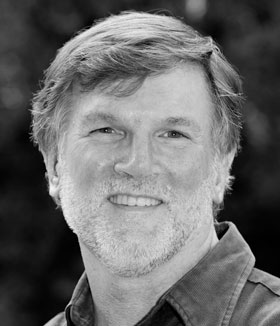
There’s a particular kind of friend who, when you turn up in his country, doesn’t ask what you’d like to see. He has already decided.
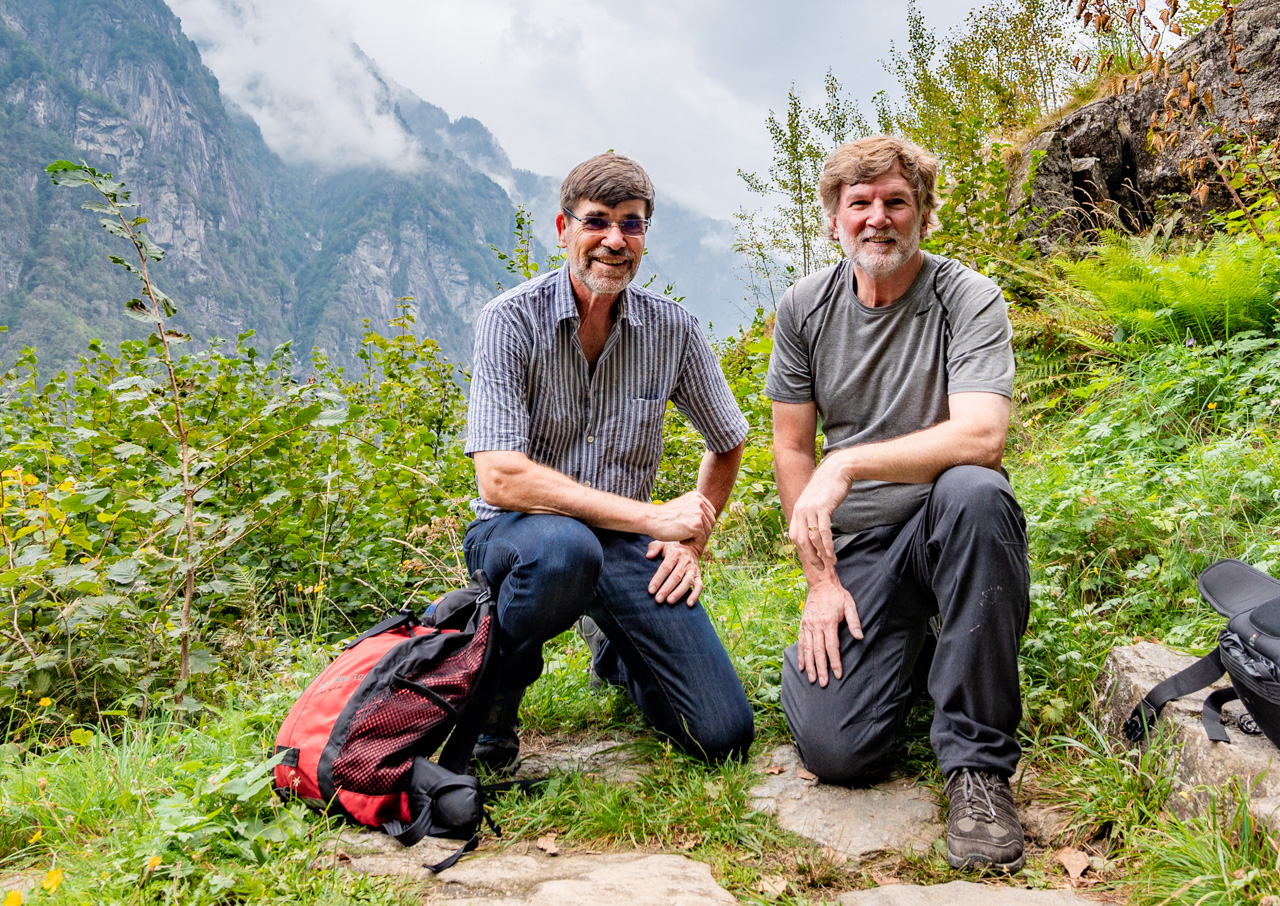
I have known Hans Striker since 1981, when I met him on a train in Mexico. He was a medical student then, working his way through an extended holiday of the kind medical students used to be able to take. He’s a vascular specialist in Locarno now, and has lived at the top end of Lake Maggiore long enough to have walked most of what is behind it, and he knows which turn-off is worth taking and which one only looks like it is.
So when Hans said, on our first morning in Ticino, that we were going up the Bavona, Padma and I jumped in the car with confidence.
Ticino is a canton of valleys, and they are not interchangeable. The Bavona runs about ten kilometres north-west off the Maggia, from Cavergno up to San Carlo, and it is routinely described as the steepest and rockiest valley in the whole Alpine region – which sounds like tourist-board arithmetic until you are in it.
The walls of the valley go up two thousand metres in almost no horizontal distance at all, so the sky arrives as a strip rather than a dome and you find yourself leaning forward in the car seat to see where it ends.
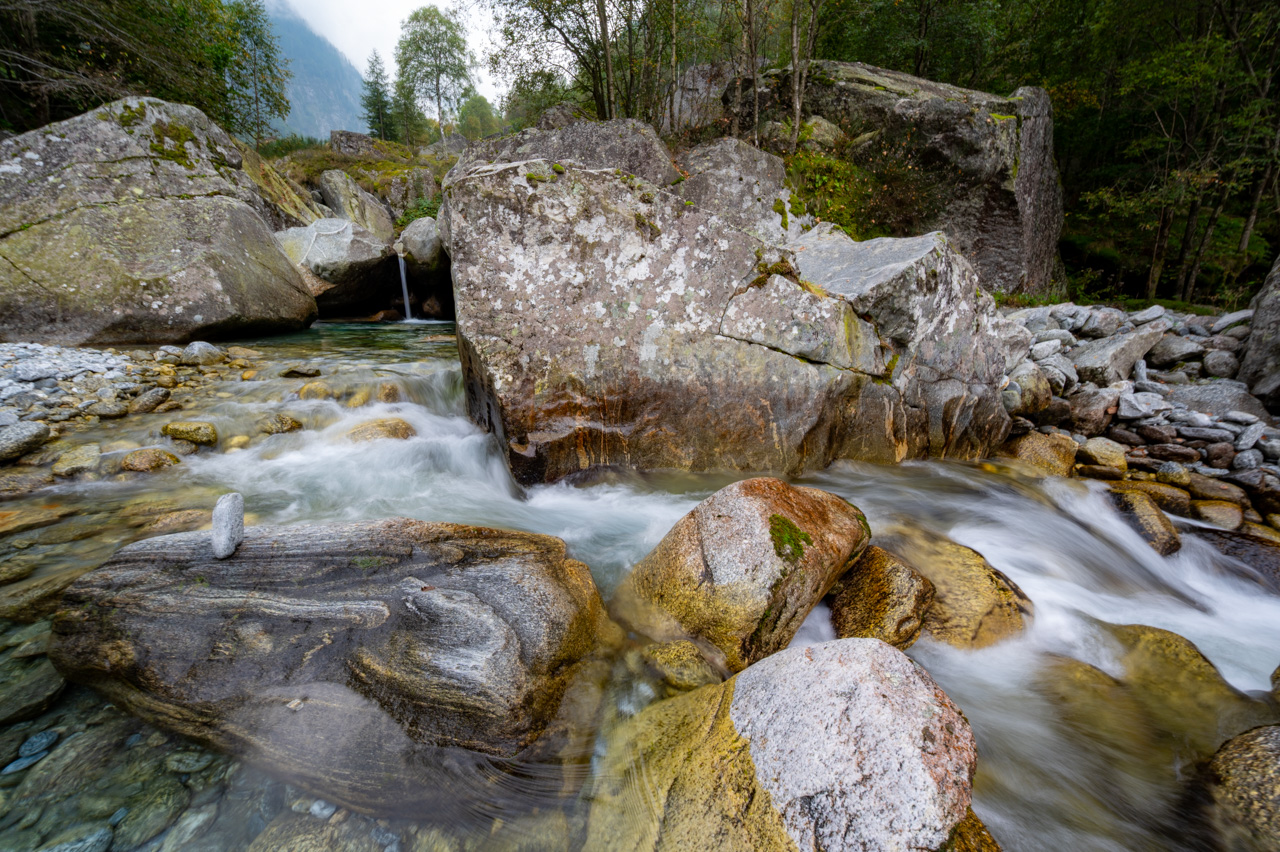
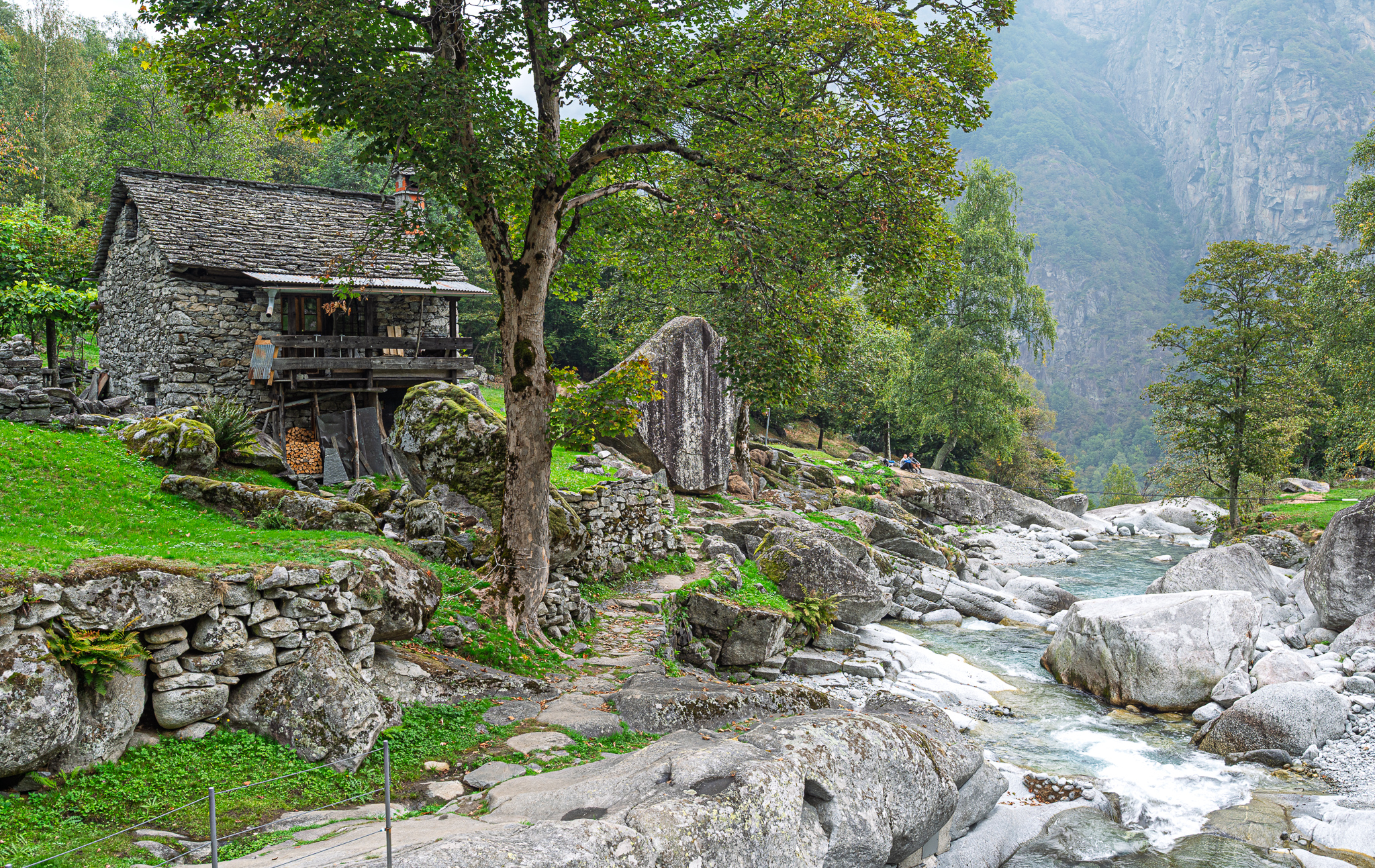
And everywhere, boulders. Not scattered stones – boulders the size of farm sheds, the size of houses, tipped across the valley floor at angles that make no sense until you understand they were not placed but dropped. The old explanation was a war between giants, which is as good an account as any if you don’t happen to have a glacier to hand.
The real story is duller and stranger. Ice came down this trough and scoured it into the classic U, plucking rock off the walls as it went. Then the ice left, and the walls it had been holding up for millennia found themselves unsupported, and they came down. They have been coming down ever since. When it rains the cliffs run with waterfalls – hundreds of them – onto a narrow strip of ground that has never once been safe.
People lived here anyway, and what they did with those boulders is a story for the next post. There is still no mains electricity anywhere in the valley except at San Carlo. In winter it empties out altogether.
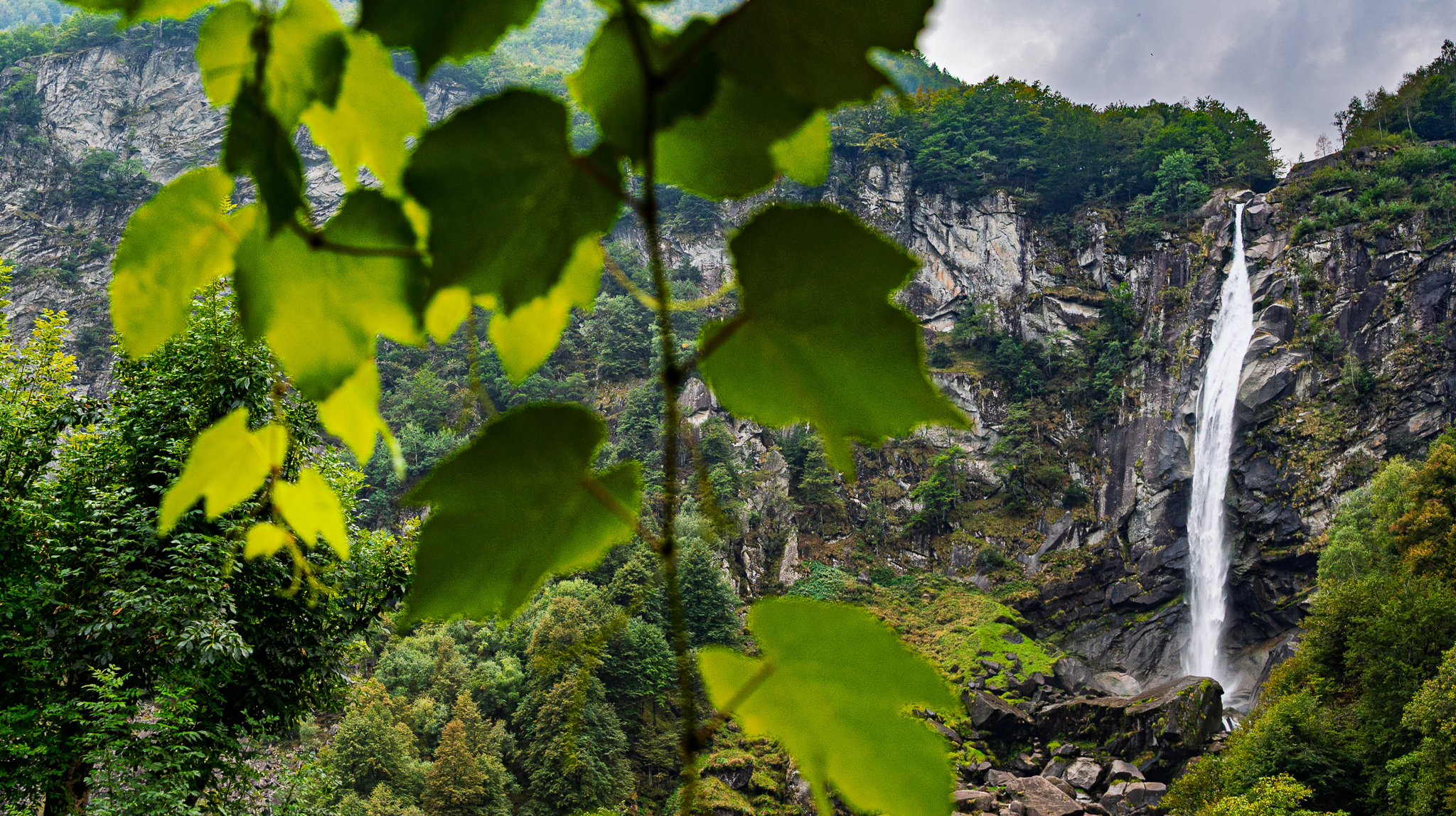
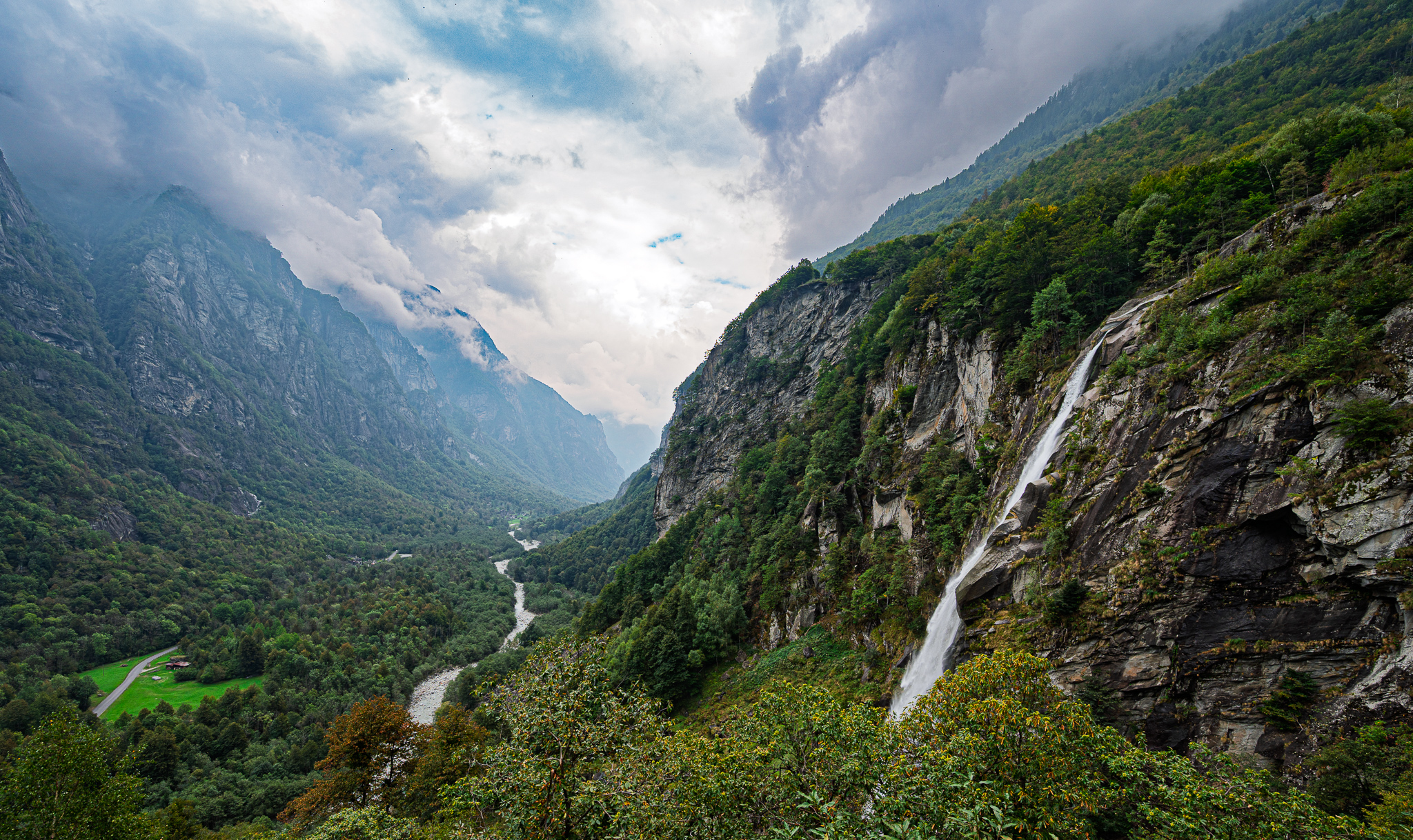
Two glaciers met at this spot. The big one filled the Bavona and ground its floor deep. The smaller one came down what is now the Val Calnègia, off to the west, and being smaller it had less mass and less abrasive power and could not cut anywhere near as deep. When the ice went, the Bavona was left as a deep trough and the Calnègia was left stranded above it – a hanging valley, its floor ending in mid-air a hundred and ten metres up. The Calnègia stream has been dealing with that problem ever since. It has no option but to jump.
The Italian name for what lies above is the better one: la valle prima del salto, the valley before the drop.
Hans asked, in the mild way of a man who already knows the answer, whether we felt like going to the top.
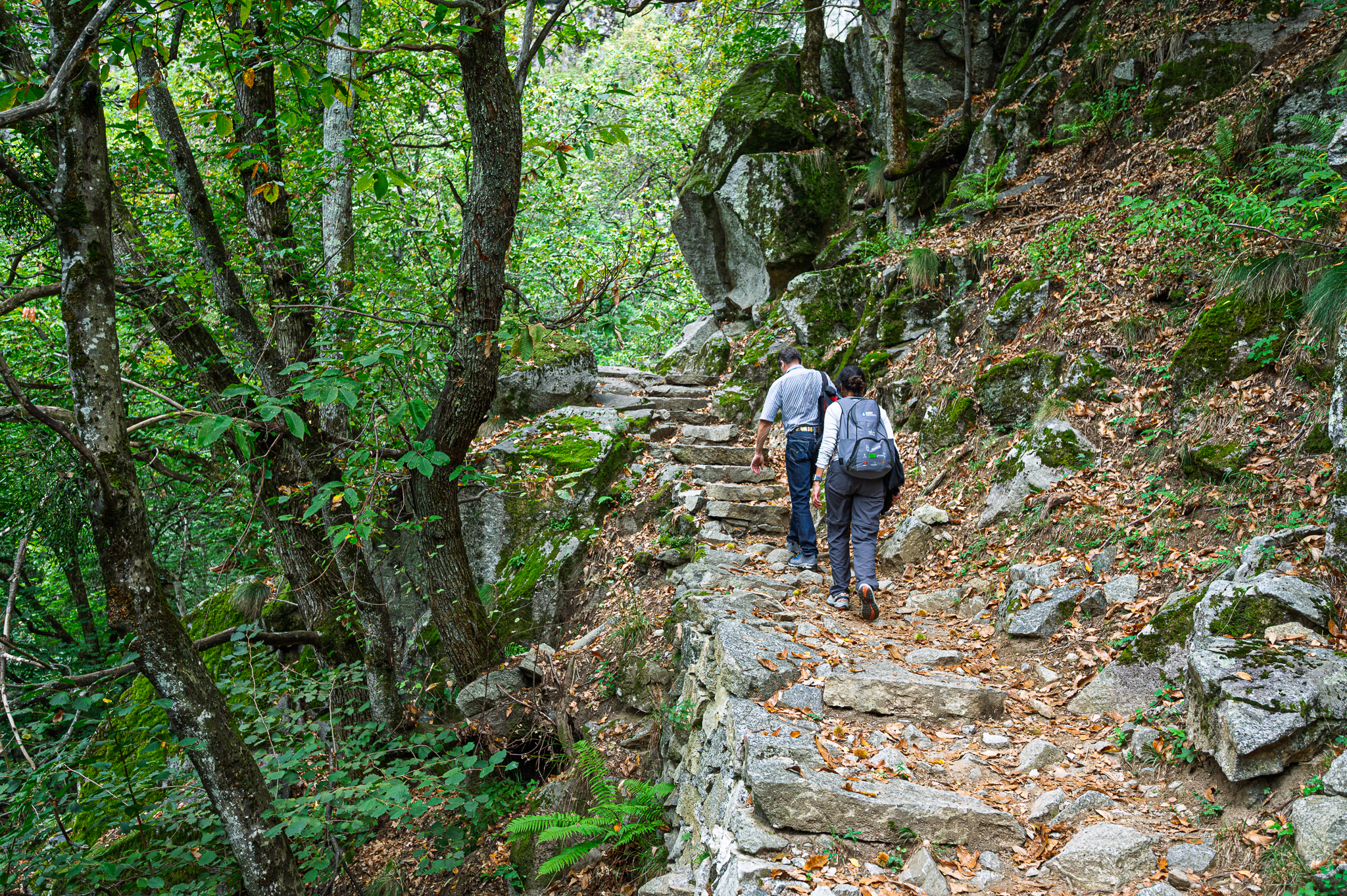
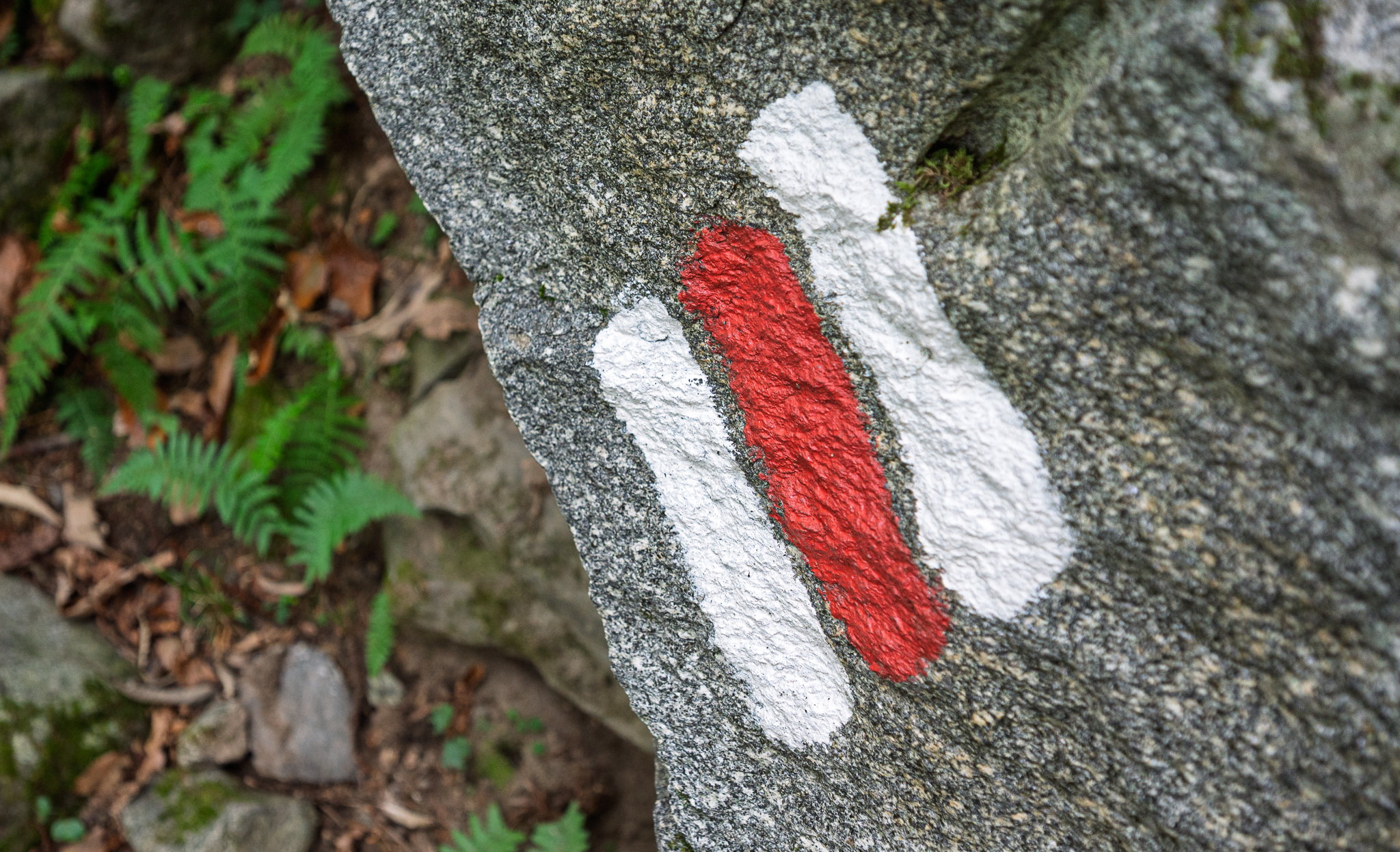
The path starts in the village, past the fountain, and turns uphill into the woods almost at once. It isn’t a path beside the waterfall. You leave the fall behind within a minute and climb a stone staircase through chestnut and beech, laid course by course by people who needed to get animals up it, with steel cables strung along the exposed traverses and white-red-white blazes painted on the boulders – the Swiss code for a mountain path. The sign at the bottom says thirty-five minutes to Puntid. It’s two hundred metres of climb, and it’s honest work.
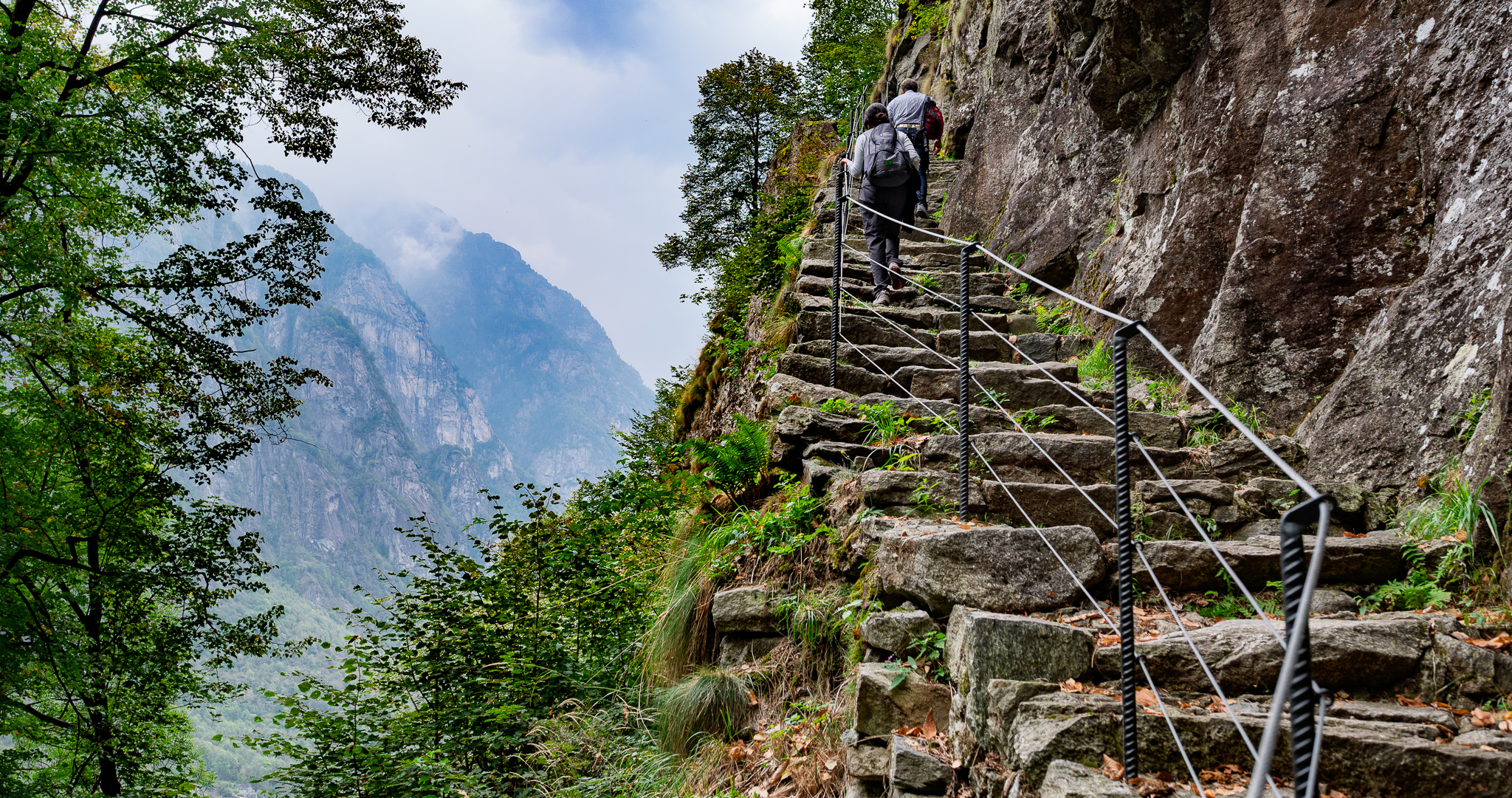
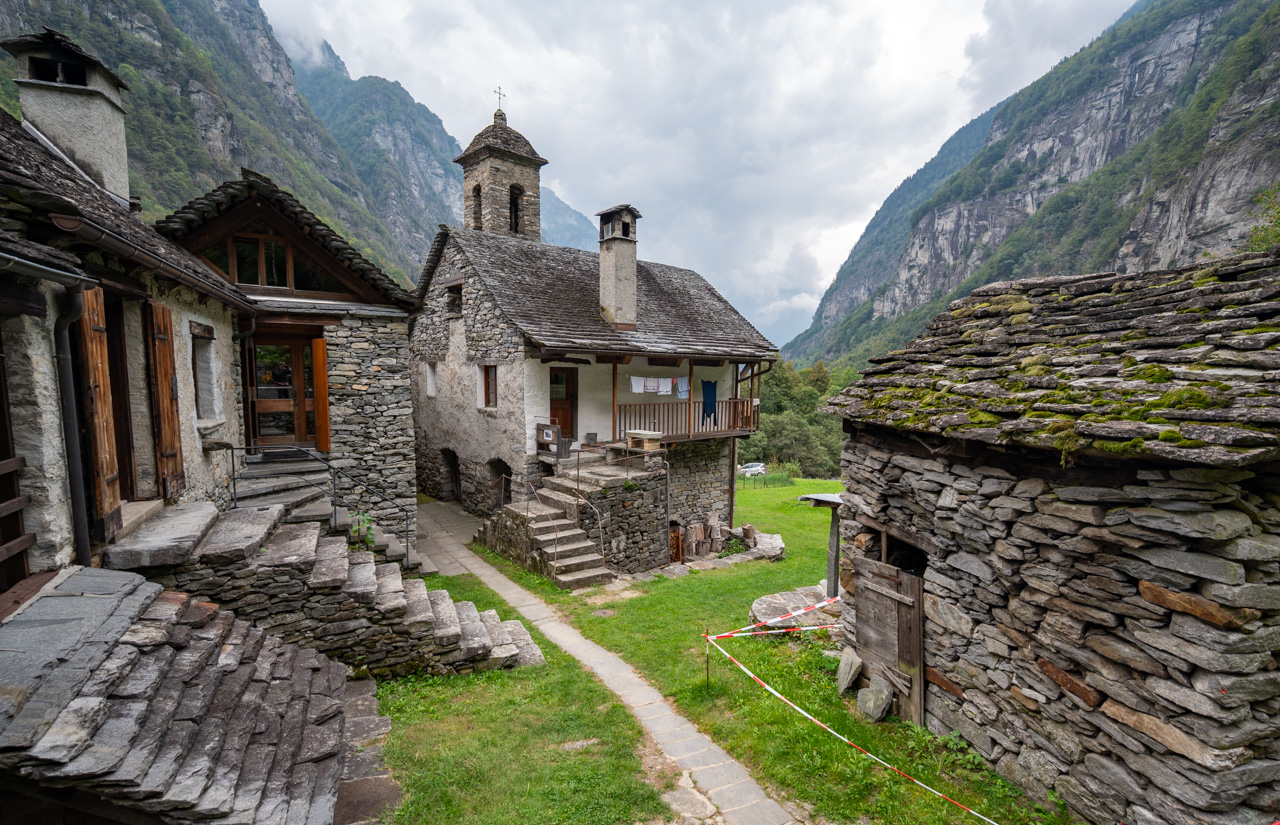
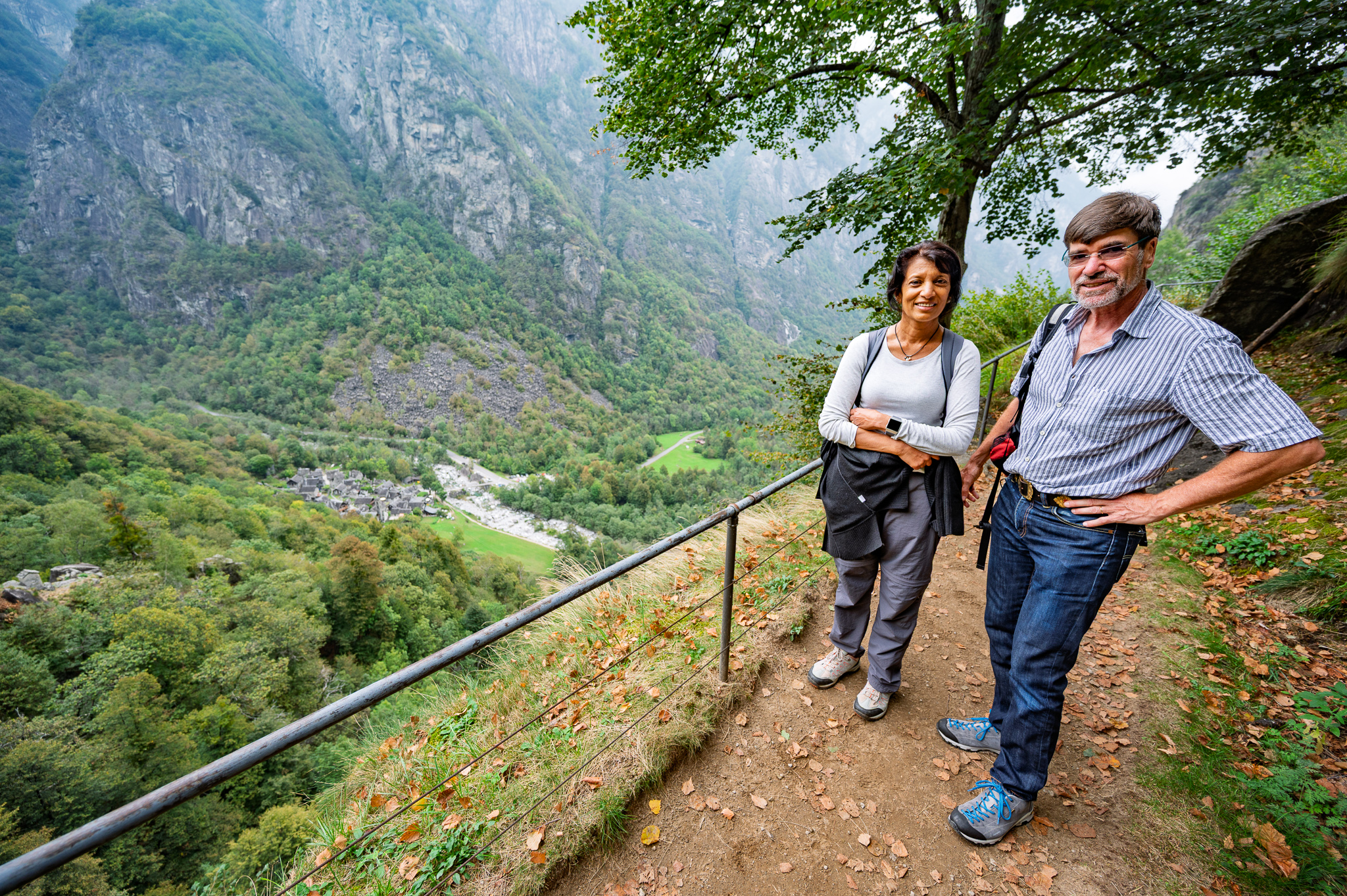
Padma and I sweated our way up, stopping often, ostensibly for photographs. Ostensibly, but the stops earned themselves. Each time the trees opened we were higher above the Bavona: the stone roofs of Foroglio directly beneath us, the river a pale braid on the valley floor, and across the gap the opposite wall with a grey fan of rockfall spilling out of it into the forest.
Of the waterfall, once we were in among the trees, there was nothing at all but noise.
Then the forest ends.
There’s no lip, no railing above the drop, no moment of looking down the fall. The trail simply runs out of trees and sets you on a flat green shelf with a river crossing it, and it takes a second to work out that this is the same water you were photographing an hour ago from the bottom of a cliff. It goes over the edge somewhere off to the left, out of sight, through a run of scoured pools that are beautiful and, the local advice is blunt about this, dangerous.
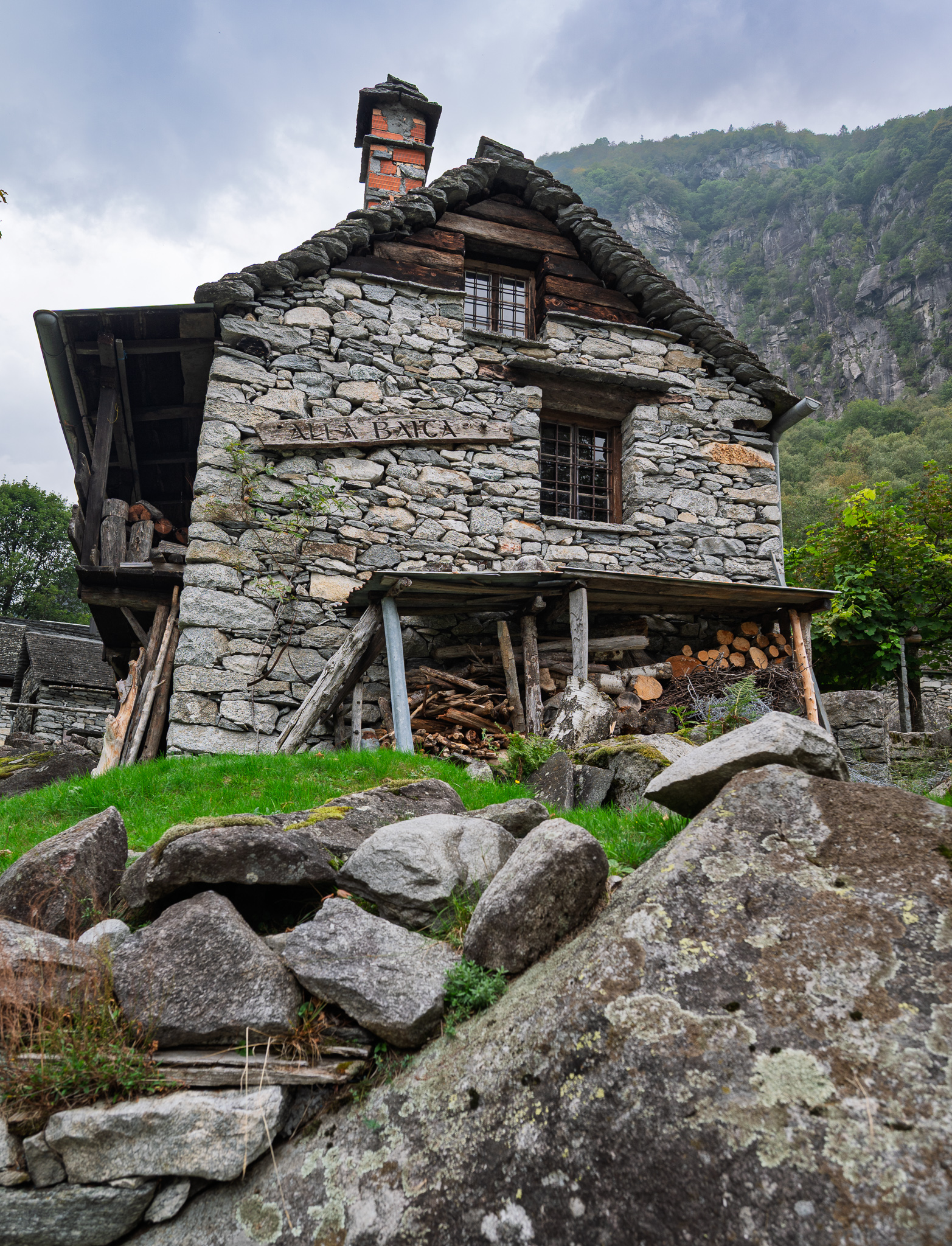
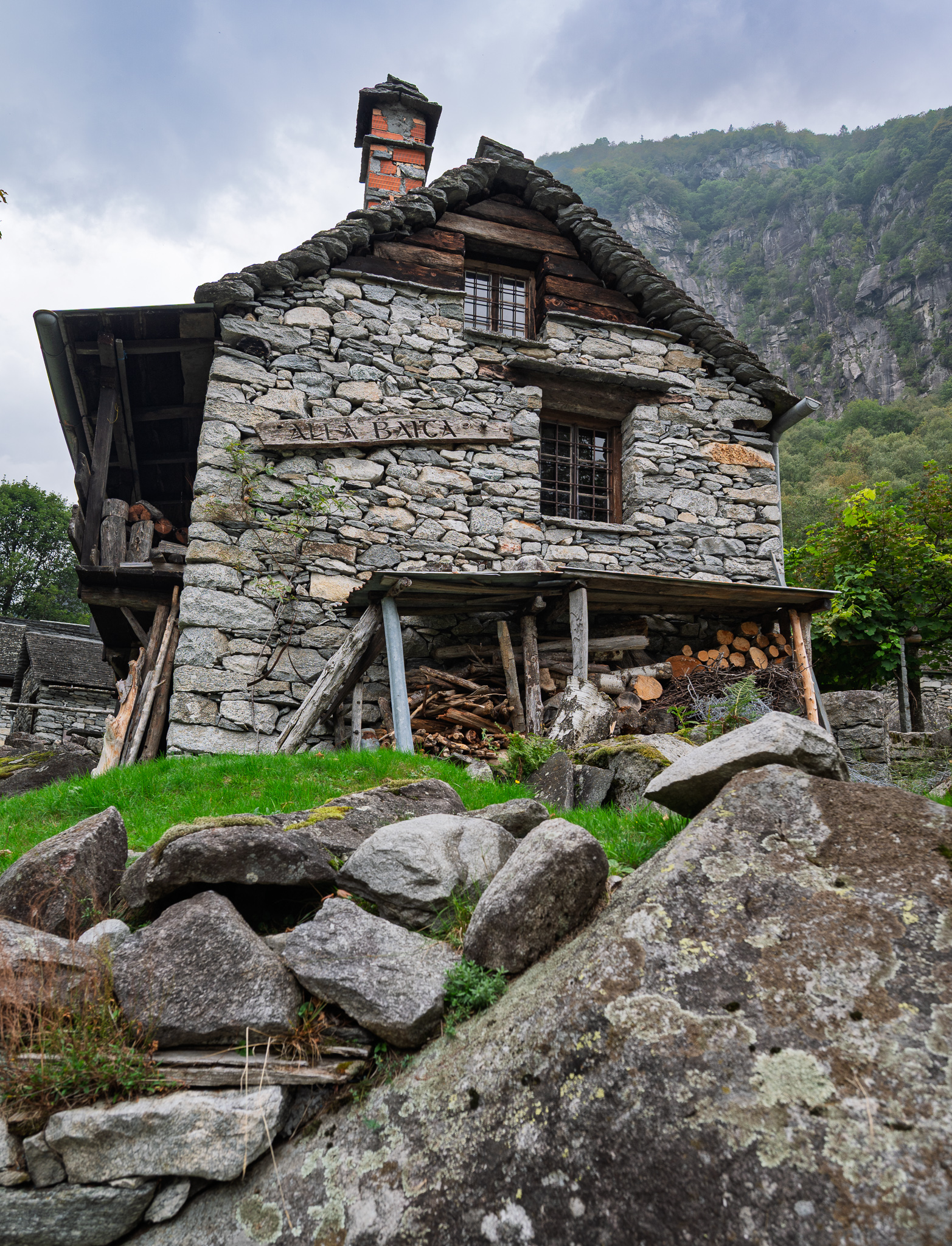
This is Puntid – not a village so much as a maggengo, one of the hay meadows that were mown in spring and again in autumn as families moved their animals up the valley and back. There are three of them in the Calnègia. This is the lowest, at eight hundred and ninety metres, and its cut grass and tidy little baite come as a shock after the wildness of the climb. One of the huts has a length of weathered timber fixed to the wall with ALLA BAITA carved into it, someone naming their house the way you’d nail up a slate reading The Cottage.
The Val Calnègia opens ahead: about three kilometres long, walled in on both sides, reachable only on foot. It climbs barely two hundred metres over its whole length, and the peaks around it are steep enough that it gets almost no sun through the winter.
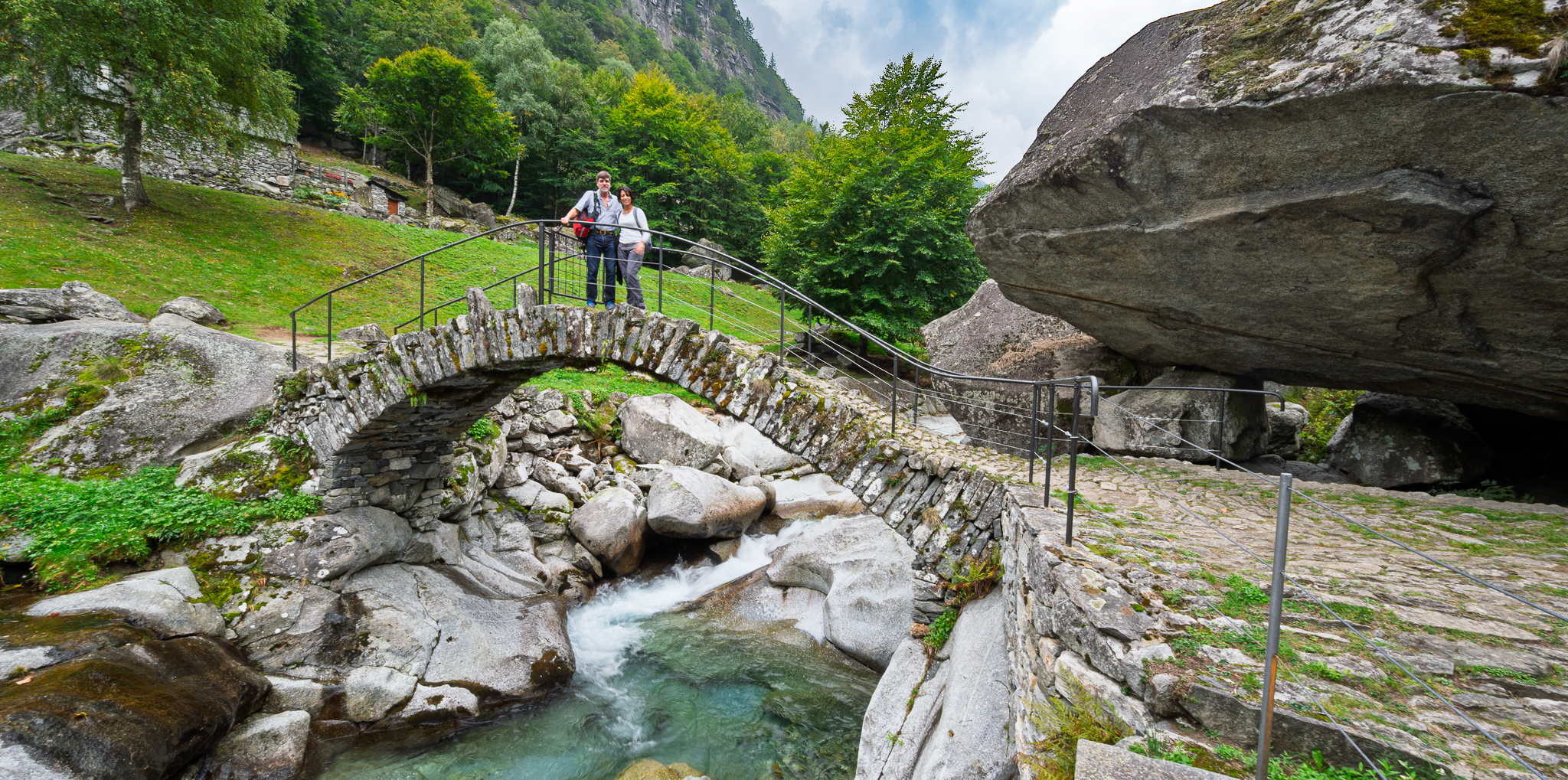
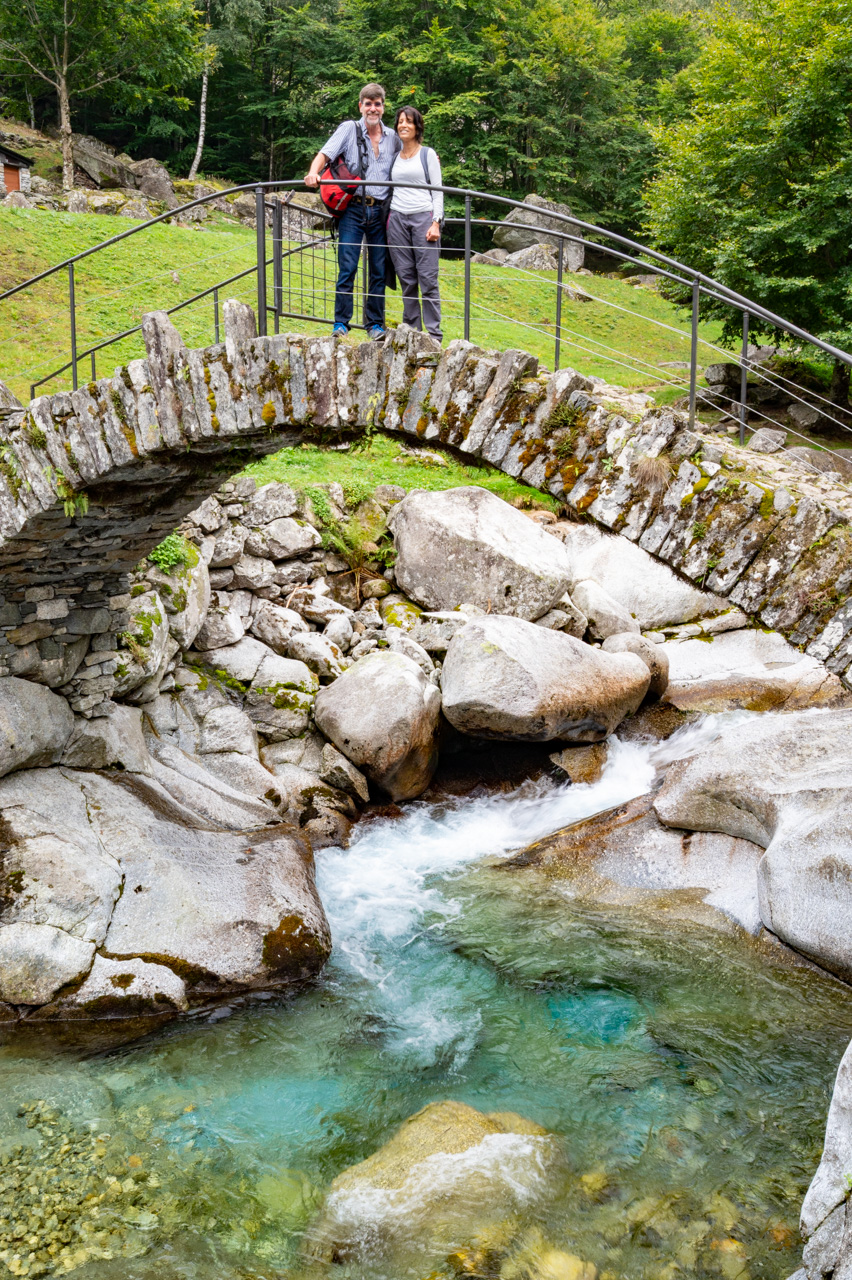
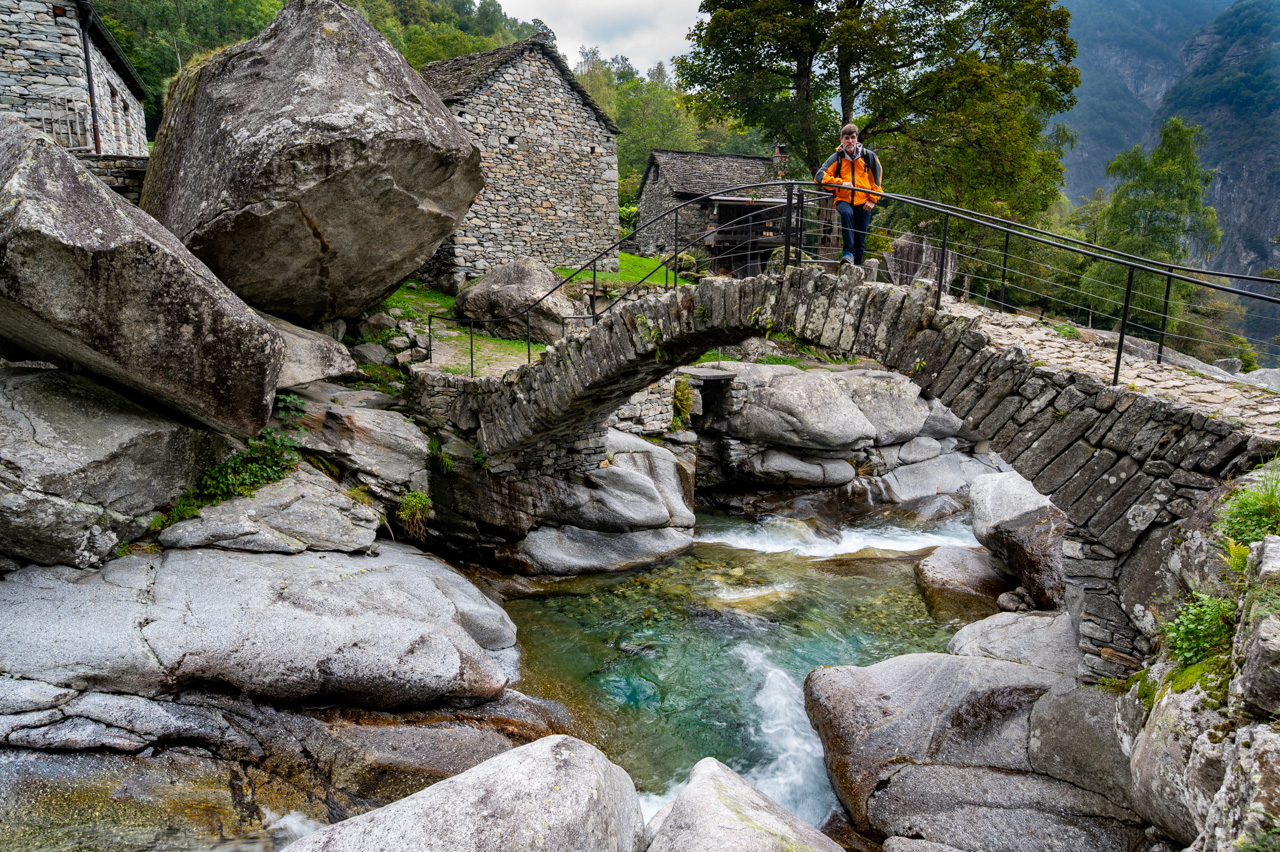
The bridge is the reason to stop. A slender humped arch of drystone thrown over the Calnègia just above the point where the water goes over the edge, cobbled at either end, with a thin steel handrail added at some later date. The bridge looks decorative but it isn’t. It was built because the huts on the far bank had to be reachable with animals, and the humped profile is simply what you do when your only material is stone and your only technique is compression.
We hiked on and ten minutes further on, we came to the Splüia Bèla, and to Arnoldo.
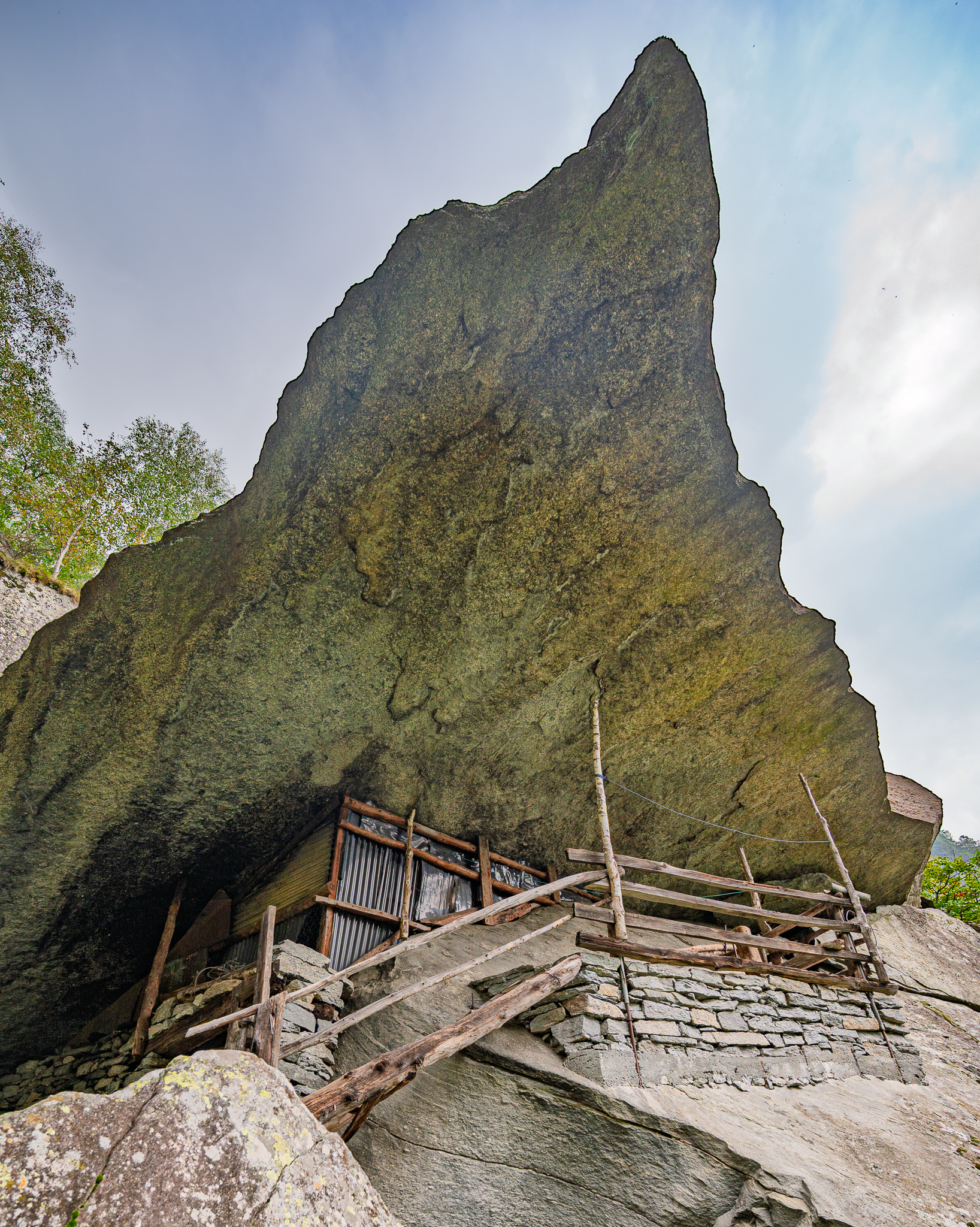
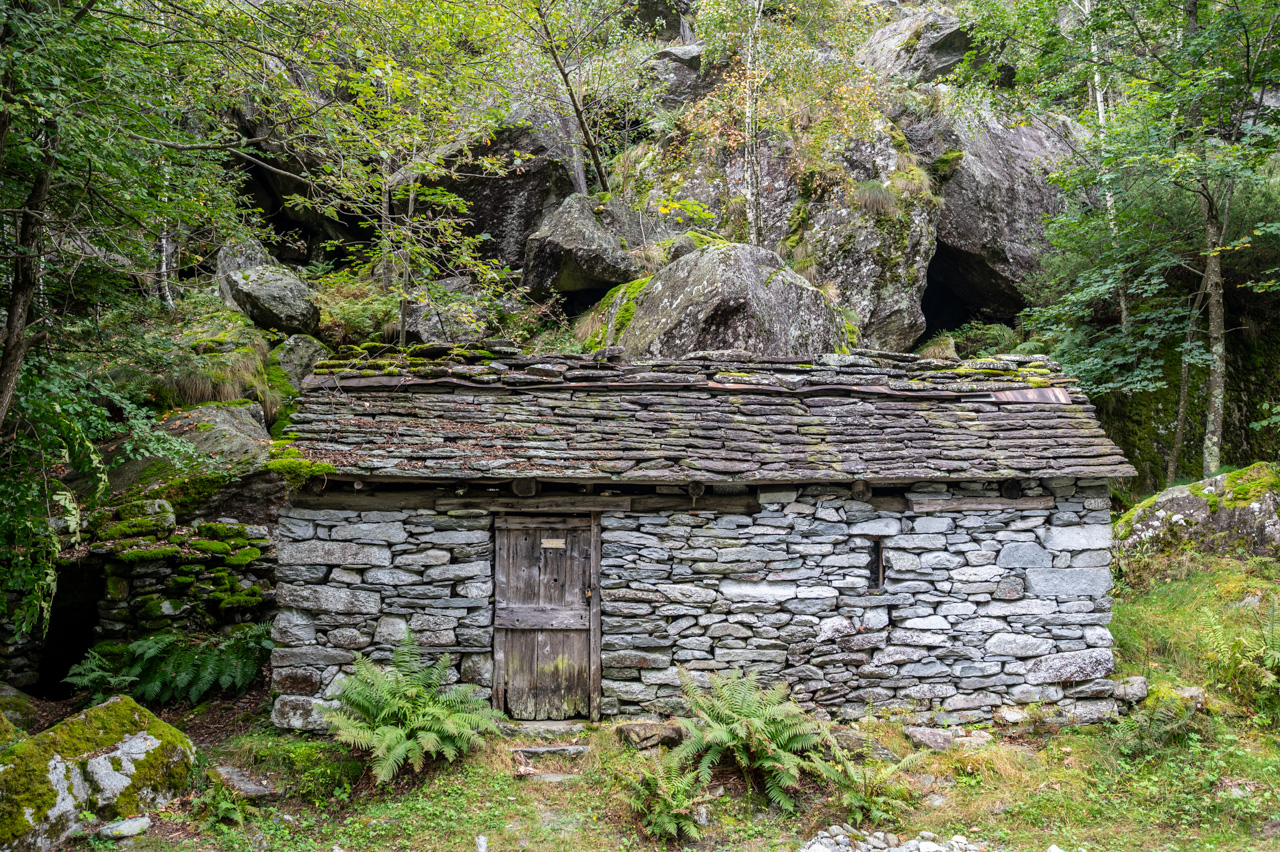
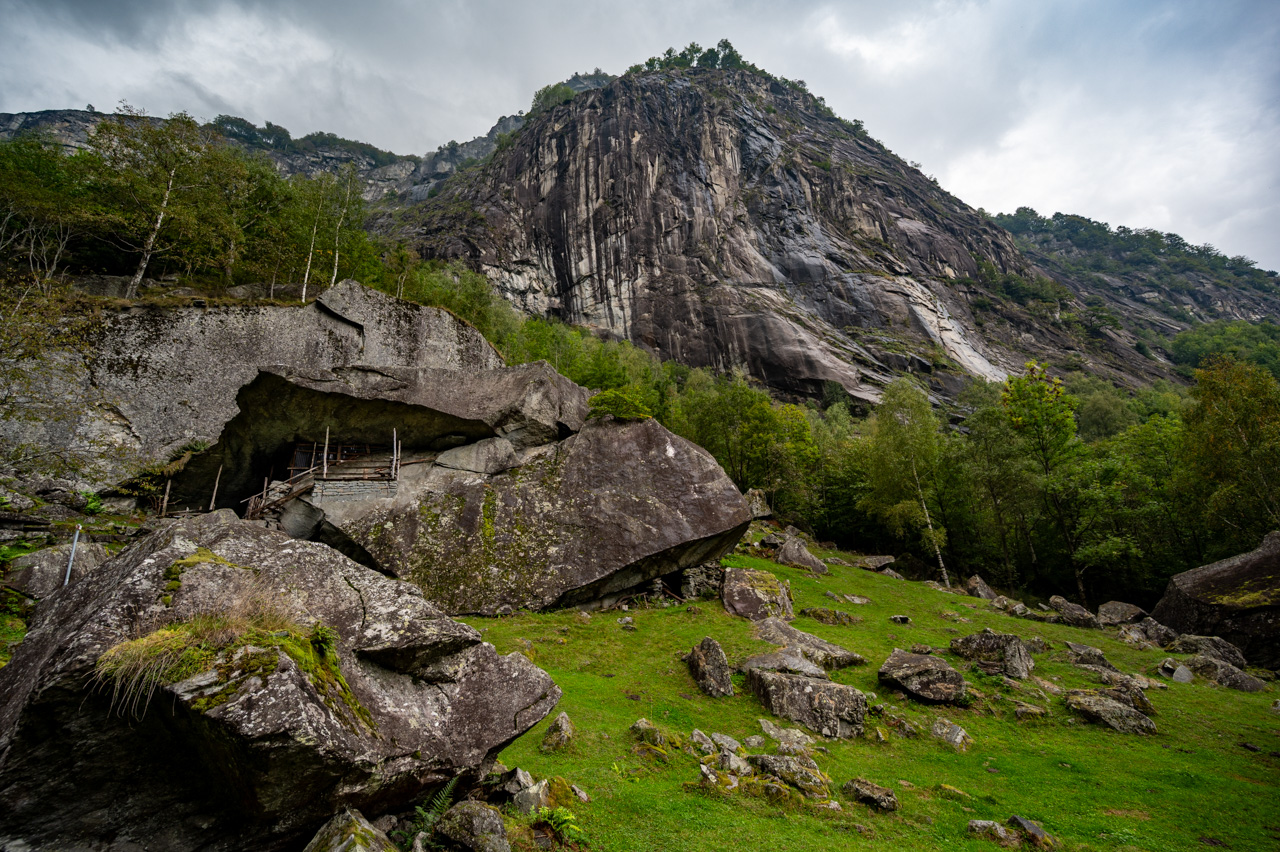
The Splüia Bèla is what happens when a piece of mountain lands well. A blade of rock more than thirty metres long has tipped forward off the cliff and come to rest against a smaller fragment, and in the wedge of shelter underneath it somebody walled in two rooms. One has the hearth, a sleeping platform on a wooden loft, and not much else; the other is larger, cobbled, and took the whole herd. A narrow passage connects them, so that in bad weather the man could go from byre to bed without stepping outside, which the local account describes, drily, as a real luxury by the standards of these alps. Scattered around it are the accessories of a working life: cellars, storerooms, pigsties, a latrine. An archaeological probe under one of them turned up a hearth with charcoal from the late Bronze Age, somewhere between 1400 and 1150 BC.
Fixed to a drystone wall with four rusting iron pins is a small painted panel. A man’s face, white-haired, blue-eyed, deeply lined, with the valley behind him and goats picking their way across the boulders. In ricordo di Arnoldo Dadò, 1916–2002, l’ultimo alpeggiante di Formazzöö e Splüja Bèla.
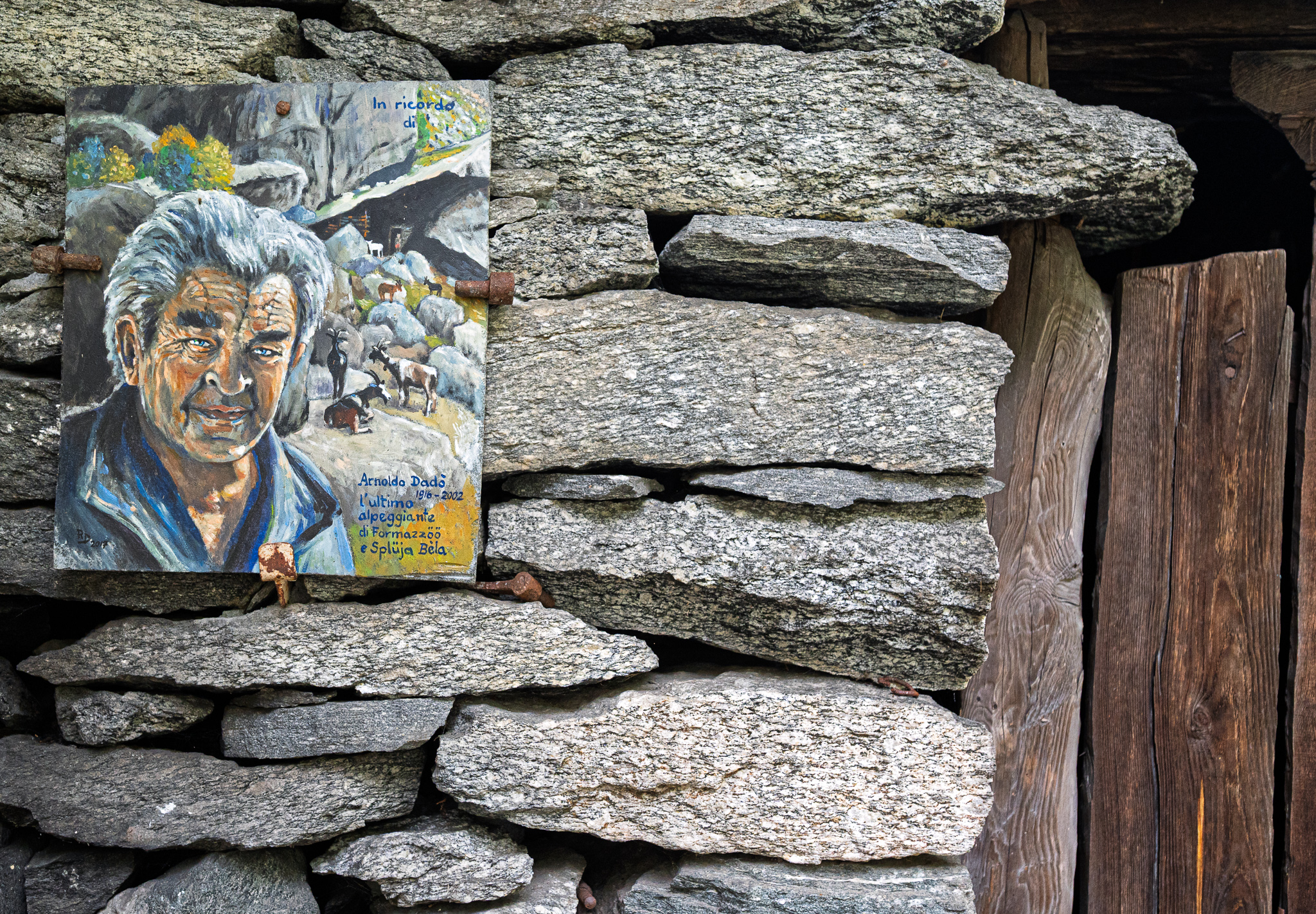
The last man to work the high alp of Formazzöö and the shelter under this rock.
Hans told us the story about Arnoldo, and I looked him up afterwards. Arnoldo Dadò turns out to have been the last alpigiano of the Val Bavona, and he had one improbable stroke of fortune: a woman from the city found him. Giovanna Silvani came up into the Calnègia and got to talking to him, and kept coming back for seventeen years. When he died in 2002 she went up into those mountains again, found the valley was not the same without him, and out of that decided to write down the stories he had told her over all that time. Arnoldo l’alpigiano: un mito, una leggenda was published in 2010. Giovanna says the book is aimed at young Ticinesi, so that they don’t forget how their grandparents were still living in the 1900s – in harsh country, on stubborn willpower, through family tragedy, poverty and early death.
So the goats in the painting are his goats. The hearth in the first room is his hearth, and someone’s before him, and someone’s before that, back to a fire lit under the same rock three thousand years earlier.
The trail continues to Gerra and Calnègia but the light had been flattening all afternoon, cloud was coming down over the tops at the head of the valley, and the grey walls that had looked merely severe on the way up began to look like weather. In a place where every cliff turns into a waterfall the moment it rains, and where nobody’s phone works, you take the hint. We turned around at the Splüia Bèla and hiked back down.
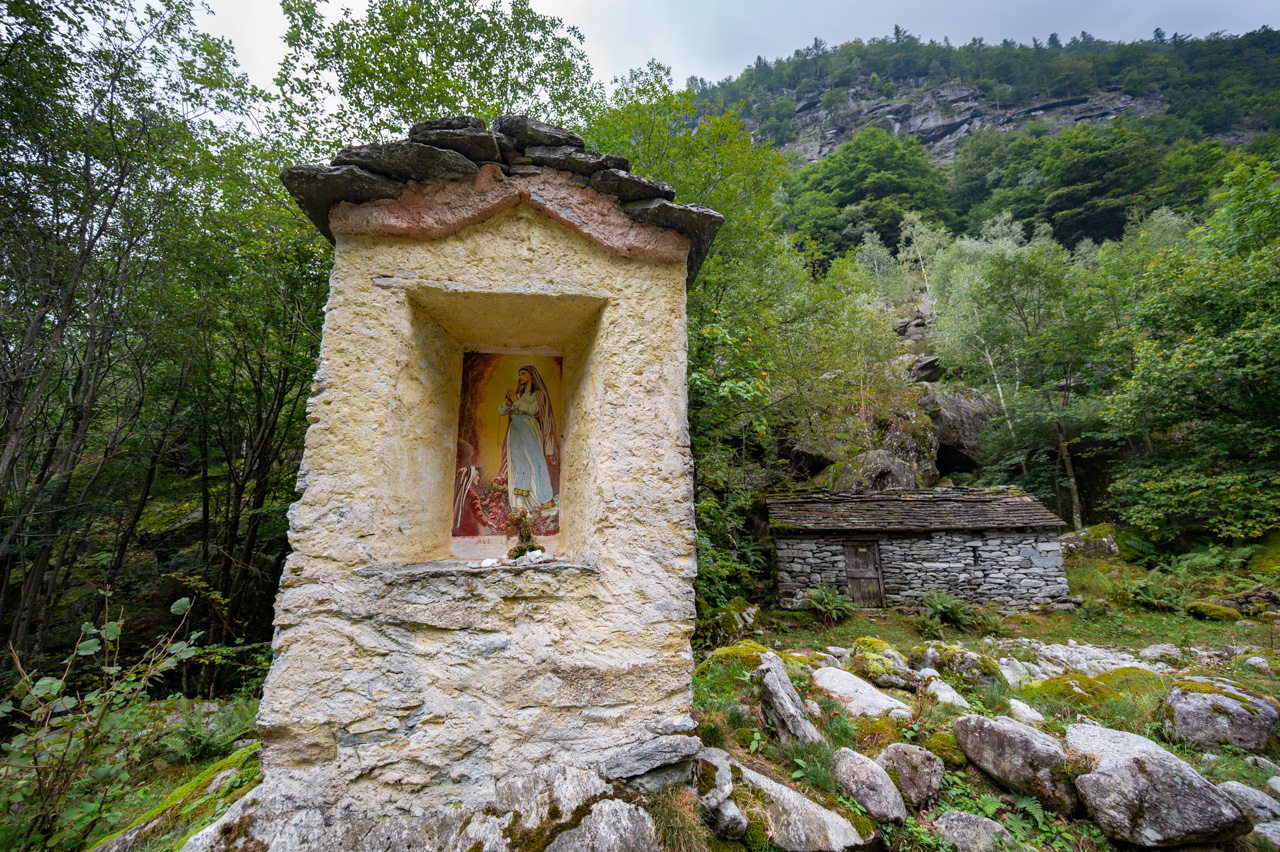
The descent was slower than the climb, the way descents on stone always are. We passed the shrines set into boulders at the turns of the path, went back through the chestnuts, and came out in Foroglio with the waterfall going full and loud beside us and the first rain just starting.
Driving out that evening the Bavona did its trick in reverse: the walls closing, the boulders coming back, the strip of sky narrowing again. I thought about how completely we’d have missed it. It isn’t hidden. It’s on the map, it has a bus and a car park and a restaurant at the foot of the falls. But it’s forty minutes off the road to somewhere else, and without Hans we’d have driven straight past the turn-off and never known what was up it.
That’s the whole argument for a friend who knows his own country. Not the facts; you can read the facts. It’s the turning.
Arnoldo Dadò got the same kind of luck, in the end. A stranger came up the path, kept coming back for seventeen years, and wrote down what he said. Otherwise there’d be nothing on that wall but rock.